The Effect of Globalisation on Design
Globalisation has affected everyone. It has made connections easier and the potential for your work to be exposed much faster. It has opened one’s thinking to learn about different styles, cultures and needs of different clients. Personally, I have witnessed this during my time working in JWT which is a global agency part of WPP. In my agency based in Bahrain, I had colleagues from all around the world. We shared knowledge and different design styles which made me think of things from different perspectives. I worked with Indians, Egyptians, Algerians, Canadians, Lebanese, Brazilians, Bahrainis, and Filipinos. It was quite an interesting dynamic team of designers.

Companies must decide on the design of their products to cater for local and global customers at the same time. “Multinational corporations, such as Unilever, who once sold the same product they developed for consumers in their home market and launched it in the global marketplace now enlist designers to develop new products that will appeal to all the multicultural consumers of the world.”
I think we should call it “the global designer” because he/she must think about the global consumer in various markets. There are no longer the boundaries for countries, as it has become a borderless world due to online communication. Designers have entered new markets and expanded in their businesses and are trying to understand different cultures to cater their needs. The designer must be a global thinker; hence, the horizon of thinking has expanded drastically with time. Designers must deliver fast and effectively. With the advancement of technology, the client is just around the corner and all artworks can be sent in minutes via email.
Also, designers had to learn new ways of designs due to digital communication. New roles and responsibilities have emerged, such as, web design, interactive design, UX/UI designs, etc. New techniques are also a requirement must, such as, videography and animation. With globalization and digitalization, I feel that the demands have been consolidated and designers have been challenged to stay up to the game in order to deliver.
Guest Lecture: The Effect of Globalisation on Design (Reflection)
In this second lecture, Harriet Ferguson of Pearlfisher reflects on graphic design practice globally and broadly.
Firstly, she talked about collaboration. Her situation is very similar to the cultural diversity I had within my local team. Different learning curves and different experiences are put together to better serve the client. It broadens your horizon of thinking. With collaboration and first-person experience, you can tackle cultural differences and understand the client’s needs.
Secondly, she talked about inspiration. The internet is not enough as there’s trending designs that are common globally and used by everyone. However, one must go to more specific resources of inspiration, like competition or industry. You can be inspired directly as this is specific to the industry itself. Designers must be unique and meaningful in their designs as there are many copycats out there.
Thirdly, she talked about the Future. Brands must incorporate global visions to cater to all and need to be sustainable. Famous global brands include: Apple, McDonalds, Coca-Cola, and Airbnb. Personally, I am a fan of the three of these brands: Apple, McDonalds and Coca-Cola. The most interesting brand out of these is McDonald’s. In the past few years, McDonald’s have upped their game in terms of explaining the exact food sources and how organically they are. McDonald’s UK started using organic milk supplies for its bottled milk and hot drinks. McDonald’s announced in 2008, that, in the United States and Canada, it would switch to using cooking oil that contains no trans fats for its French fries, and canola-based oil with corn and soy oils, for its baked items.
They have also given back to the community through various charity work, such as, McHappy Day, McDonald’s Monopoly Donation and McRefugee. In 2012, McDonald’s announced they would try replacing styrofoam coffee cups with an alternative material. In 2019, McDonalds switched from plastic straws to paper ones in Ireland and the United Kingdom to reduce plastic pollution.
Workshop Challenge 1: Contemporary Practice and Categorisation
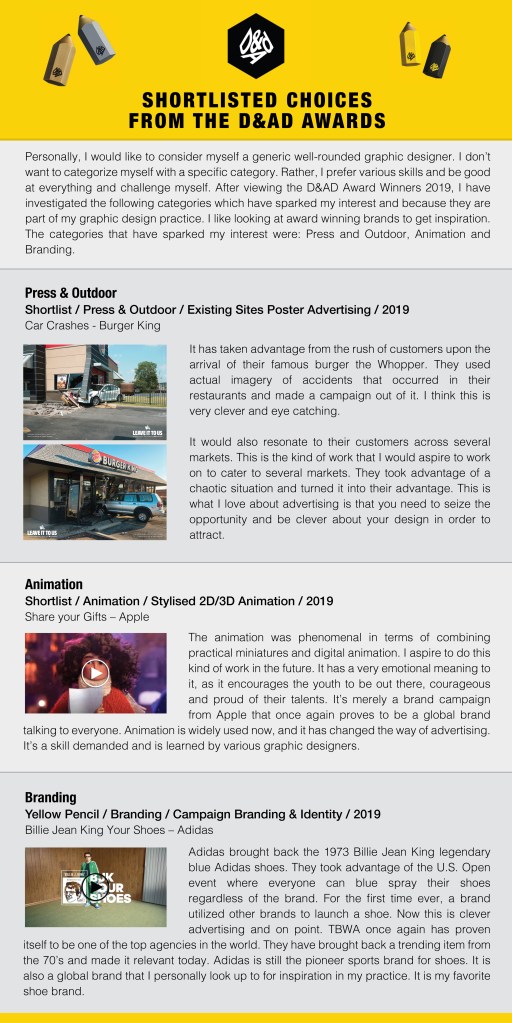
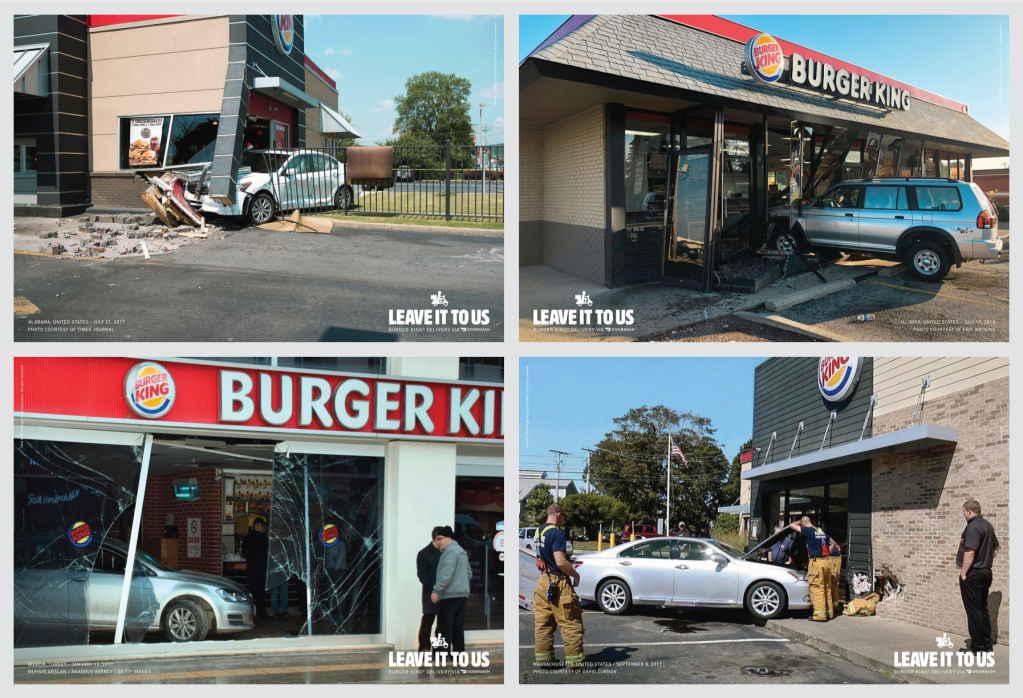
Press & Outdoor
Shortlist / Press & Outdoor / Existing Sites Poster Advertising / 2019
Car Crashes – Burger King
Animation
Shortlist / Animation / Stylised 2D/3D Animation / 2019
Share your Gifts – Apple

Branding
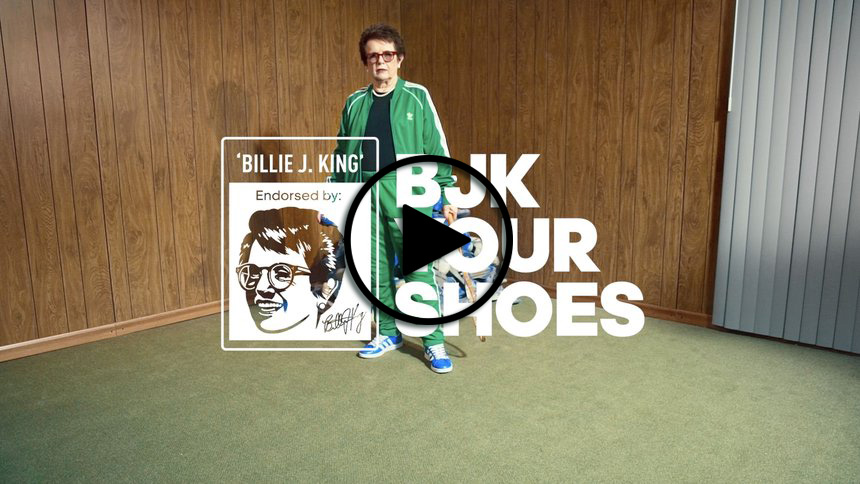
Yellow Pencil / Branding / Campaign Branding & Identity / 2019
Billie Jean King Your Shoes – Adidas
Week 3: Workshop Challenge 2
10 different types of graphic design practice today:
• Production Design
• Advertising
• Product/Package design
• Environmental Design
• Video Game Art
• Publishing
• Web Design
• Interfaces (animations)
• Corporate Designs (branding)
• Signage (outdoors, billboards)
In my opinion, I believe that under production design we can include product/package design and signage. I am experienced in production design and is something that I enjoy during my daily job. I usually work on event stands and showroom branding. I work from design stage until execution stage, where I go into the details of choosing the colors, the type of material like wood or acrylic, and even the sticker material in order to bring my design idea to life. In production design, execution is key and sometimes there are challenges that face the designer. The challenge here is to work around various solutions to bring out the idea to reality. Timelines are major challenges as production takes time for all elements to be in place for the launch.
Breaking the Boundaries of Graphic Design
In my opinion, interactive design breaks the boundaries of design practice. Other skills are required as it tackles the behavior of the consumer and the interaction with the design. It not only includes design, but also includes, human-interaction and software development. These are other areas that a designer must be aware of in order to deliver on the product requirements. These skills break the boundaries of graphic design and goes beyond it into other areas. These are the new skill sets that designer must know nowadays to be up in the game of design. Interactive design includes five major dimensions: Words, Visual representations, Physical objects or space, time and behavior. Behavior defines how users respond to the interface. Users may have different reactions to this interface. A good example of this would be having a QR code on poster or collateral, where a user must scan the code to get something free or experience something. After scanning, the user will win instantly or go in a raffle to win a big prize. This interactive design must include multiple design element scenarios based on the user’s behavior and based on criteria of the user’s choices. Interactive design on website and apps may also requires coding knowledge. A new term that describes this area of work: Digital Interface Design.
Omar Mal
February 12, 2020
 Omar Mal