How Do We Generate Ideas?
According to the Interaction Design Foundation, there are five stages in the design thinking process. The five-stage Design Thinking model is proposed by the Hasso-Plattner Institute of Design at Stanford (d.school). d.school is the leading university when it comes to teaching Design Thinking. The five stages are as follows: Empathise, Define (the problem), Ideate, Prototype, and Test.
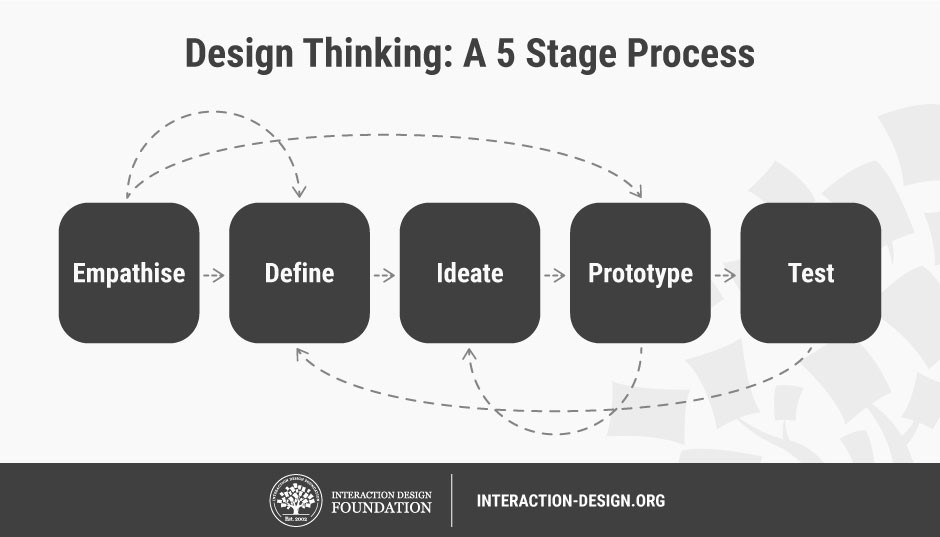
The first stage is empathy which adds a human element to the design thinking process. With empathy, design thinkers to gain insights into users and their needs. The second stage is defining the problem. This stage help designers gather ideas to establish features, functions, and other elements that will allow the users to solve the problem. The third stage is ideate. This stage help designers generate ideas in sessions (e.g. brainstorming, worst possible idea). Brainstorm and Worst Possible Idea sessions are used to stimulate free thinking and to expand the problem space. The fourth stage is prototype. This stage is experimental for designers as it aims to identify the best possible solution using prototypes. The fifth or final stage is test. This stage tests the complete product using the best solutions identified during the prototyping phase. Alterations and refinements are still made to produce the best solution.
What’s interesting and true is that the design thinking process is a non-linear process. This can be evident in my daily job as a designer. My clients would brief us with a problem that are facing by their users. And they want us to come up with the best solution. Along with the planning team, we need to conduct research (between the define and ideation) stages in order to nail down what needs to be done. I feel the prototype and testing phases are combined as we conduct focus groups and surveys to gain more insights. Once the best solution is clear, we go back to the drawing board and enhance our concepts and communication. Once the initial stages are done, one still needs to go back for refinements in order to answer the brief.
After further research, I found this very interesting blog on “How the Design Process Has Evolved” by Sheena Lyonnais. It basically discusses how designers have shifted their way of thinking due to the digital transformation. Hence, new job titles within design has emerged.
“We are taking the different parts of the design process (designing, prototyping, sharing, collaborating, reviewing) and we are organizing all of those workflows around a single product and we are building it as a design platform.” Due to technology, the design thinking process has changed, and many steps have merged together. Clients are demanding to see prototypes that are near to actual as they want to test not only the product, but also the experience. Adaption is the key to a designer’s success.
According to the Design Council, the Double Diamond process model is the simplest way of mapping the design process (Discover, Define, Develop and Deliver).
Step 1: Discover: the designer should explore various perspectives of the problem in matter. Several methods include creating a project space, observation, user diaries, being your users, brainstorming, choosing a sample (a focus group), quantitative surveys, fast visualization, secondary research, and express hopes and fears.
Step 2: Define: the designer should explore several methods to narrow down insights and establish the project’s main challenge. These methods include focus groups, assessment criteria, comparing notes, drivers and hurdles, and customer journey mapping.
Step 3: Develop: the designer should explore several methods to brainstorm design, test out what works and discard what does not. These methods include character profiles, scenarios, role-playing, service blueprints, and physical prototyping.
Step 4: Deliver: the designer should use several methods to finalise, produce, launch the project and gather feedback about it. These methods include phasing, final testing, evaluation, feedback loops, and methods banks.
The steps reviewed above showcase the design process. As a designer, I am familiar with many of the methods. However, I think that some methods take time and we sometimes must work in parallel and then go back for adjustments. The focus groups are the usual part of our first methods used as we always want to test new ideas. Also, several methods are combined due to lack of time. In the delivery stage, we do test prototypes, especially in the case of adapting to different screens.
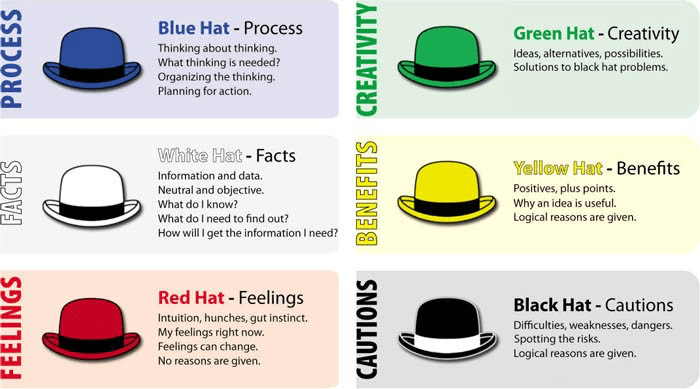
The Six Thinking Hats looks at a decision from all points of view. Six Thinking Hats was created by Edward de Bono and published in 1985. It’s a powerful decision-checking technique used in group discussions. It can help you to look at problems from different perspectives, but one at a time, to avoid confusion from too many angles crowding your thinking.
Each “Thinking Hat” is a different style of thinking as follows:
White Hat: you focus on the available data and information.
Red Hat: you look at problems using your intuition, gut reaction, and emotion.
Black Hat: you look at a decision’s potentially negative outcomes, cautiously and defensively.
Yellow Hat: you think positively.
Green Hat: you develop creative solutions to a problem.
Blue Hat: this hat represents process control. It’s the hat worn by people chairing meetings, for example.
This is a very interesting technique that I would like to teach my colleagues about and implement it into the workplace. It allows emotion and skepticism to be brought into a purely rational process, and it opens the opportunity for creativity within decision making. Decisions made using the Six Thinking Hats technique can be sounder and more resilient. It can also help you to avoid possible pitfalls before you have committed to a decision.
Kahneman’s Mind-Clarifying Strangers: System 1 & System 2
System 1 operates automatically and quickly, with little or no effort and no sense of voluntary control. It is the intuitive, “gut reaction” way of thinking and making decisions. It forms “first impressions” and often is the reason why we jump to conclusions. While System 2 allocates attention to the effortful mental activities that demand it, including complex computations. It is the analytical, “critical thinking” way of making decisions, which does reflection, problem-solving, and analysis.
System 1 is continuously creating impressions, intuitions, and judgments based on everything we are sensing. In most cases, we go with the impression or intuition that System 1 generates. System 2 only gets involved when we encounter something unexpected that System 1 can’t automatically process. Personally, I will never be able to avoid relying on System 1 thinking for most of my daily life. The important thing is to recognize when I or when others are relying on it too much and force more System 2 thinking into the situation.
The Divided Brain
It was interesting to watch a fascinating video from RS Animate of McGilchrist explaining how our ‘divided brain’ has profoundly altered human behavior, culture, and society. It basically explains that our left and right brain hemispheres are different and conflict with one another. However, it argues that modern society prefers the left brain. But we require both sides of our brain. The “left hemisphere is detail-oriented, prefers mechanisms to living things, and is inclined to self-interest, where the right hemisphere has greater breadth, flexibility, and generosity.”
Thinking Too Much; and Thinking Too Little
The worry of failing creates self-doubt. Self-doubt will make you think small and limit your success. Then you can feel depressed. “Research shows that negative thinking is the linchpin responsible for setting off low self-esteem,” says Deborah Seranic, PhD. Overthinking also triggers anxious and depressed feelings. Being anxious makes you panic, not think clearly, and probably make a wrong move in decisions. Every important step to success in your life or career can make you think too much or too little. Confidence can make you think clearly. “When you are confident in your abilities you are happier due to your successes. When you are feeling better about your capabilities, the more energized and motivated you are to take action and achieve your goals,” says Courtney Ackerman, MSc. Depression can happen and once it does you must seek help and support. Failure is inevitable and teaches us important lessons. We must let it go and get past it to the next challenge.
Workshop Challenge
Socrates

Socrates was a classical Greek (Athenian) philosopher credited as one of the founders of Western philosophy, and as being the first moral philosopher of the Western ethical tradition of thought.
The Socratic way of thinking originated in a social environment that was exposed to major political and religious upheavals and where the old conventions lost their liability. Critical-rational thinking threatened to destroy the Pagan beliefs.
Socrates says that in his youth he was very interested in the natural sciences and wanted to know the cause of everything.
At the time, science couldn’t develop a convincing teleology, it couldn’t explain the order in the universe. Socrates stepped on the writings of Anaxagoras, a Ionian natural philosopher (who was accused of impiety because he denied the divinity of the sun).
The Ionian natural philosophers were known to be in search of the first reasons and an ordering principle of the universe. Socrates was inspired by this idea. The natural philosophers asked about the nature of the physical world, but Socrates asked about the nature of our thinking. Socrates started his own search for causes and developed new methods of gaining insight. These methods later proved to be applicable not only in the humanities but also in the natural sciences.
Although there is no pre-defined framework, Socratic conversations often deal (as in the antiquity) with the so-called “big” questions:
• Where do we come from? Who are we? Where are we going? What is the meaning of life?
• Is there anything like an “objective” truth, good and right, and if so, what is it?
• Is the “objectively” true, good and right relevant for the individual and, if so, under what conditions and to what extent?
• How can we know ourselves? How strongly are our thoughts, feelings and behavior shaped by our biography?
Many philosophical practitioners use Socrates as a paradigm for philosophizing, or indeed for what philosophical practice is all about. Socrates demands that our views pass the test of critical examination. He tells us that we need to clarify the concepts we are using, expose our hidden assumptions, and give convincing reasons that support our views. Socrates had an influence on ancient Skepticism, because his criticized (among others) the social class of the priests.
Socrates raised the challenge that it might be truly bad (for one’s life, for the state of one’s soul) to base one’s actions on unexamined beliefs. For all one knows, these beliefs could be false, and without investigation, one does not even try to break free.
His dictum that “the unexamined life is not worth living” has to be interpreted as “a life which is manipulated by false beliefs, is not worth living”.
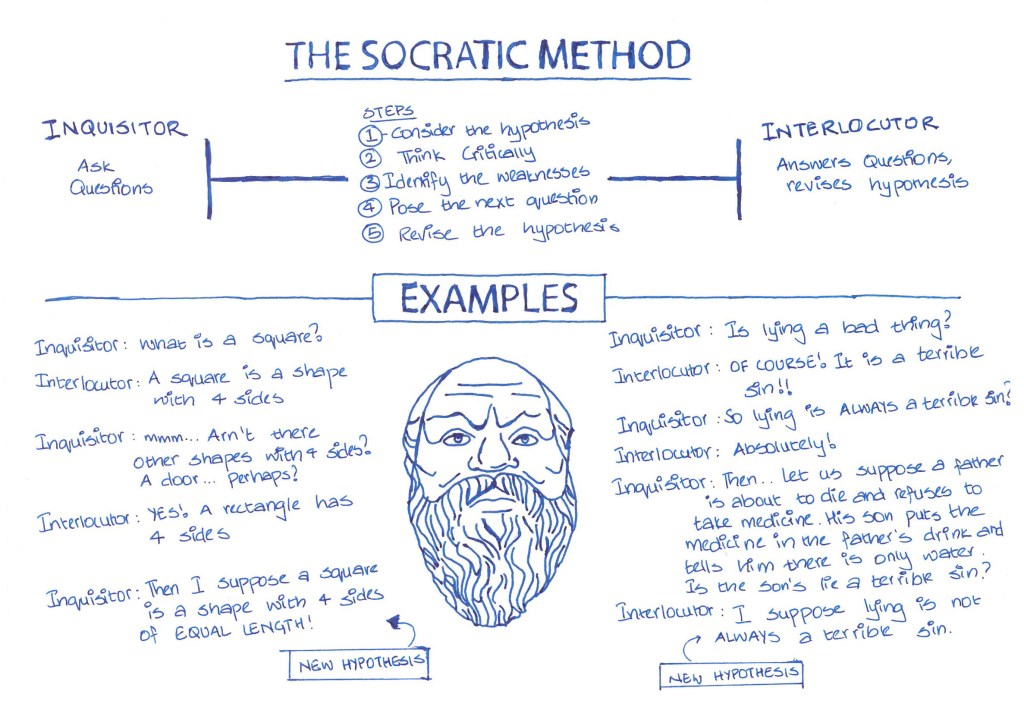
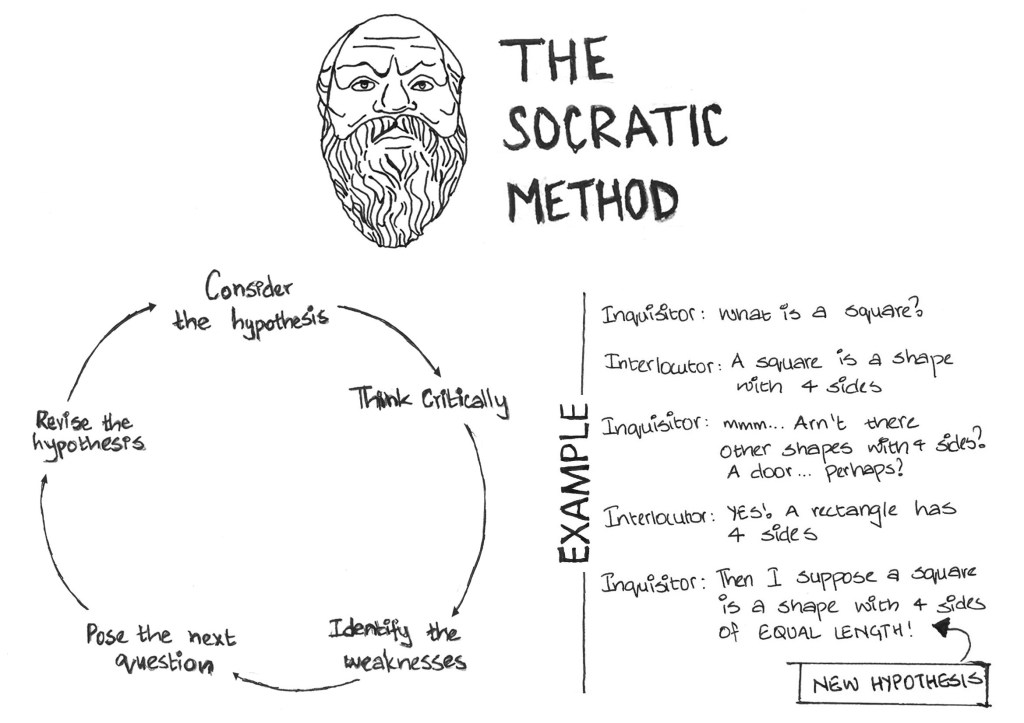
Used until this day, The Socratic method (also known as method of Elenchus, elenctic method, or Socratic debate), is a form of cooperative argumentative dialogue between individuals, based on asking and answering questions to stimulate critical thinking and to draw out ideas and underlying presuppositions. It is a dialectical method, often involving a discussion in which the defense of one point of view is questioned; one participant may lead another to contradict themselves in some way, thus weakening the defender’s point.
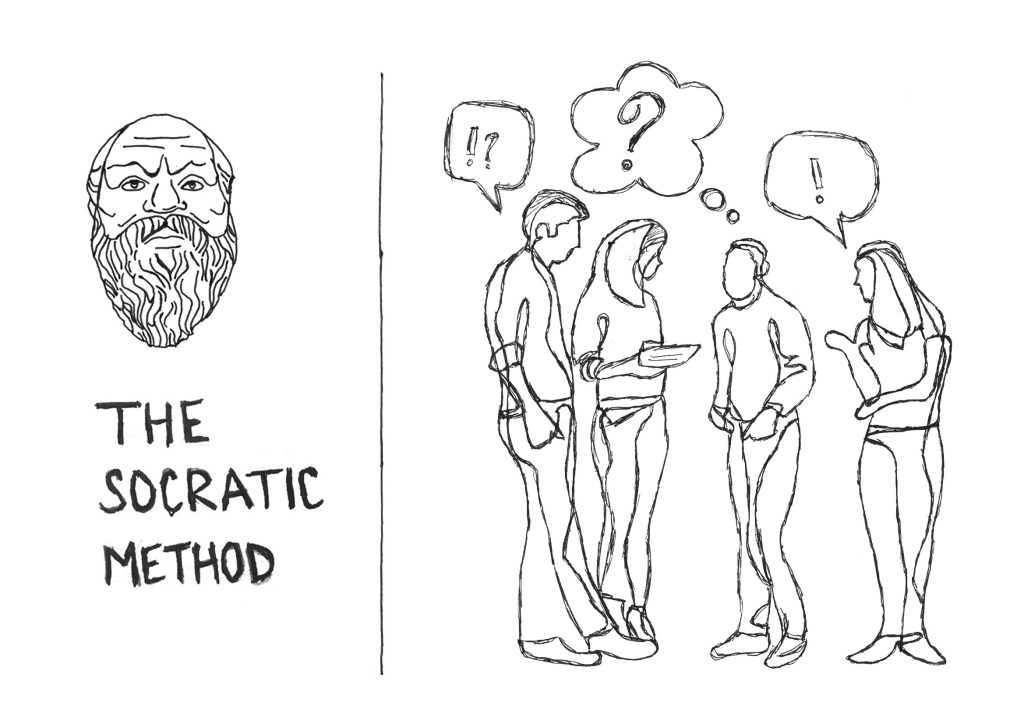
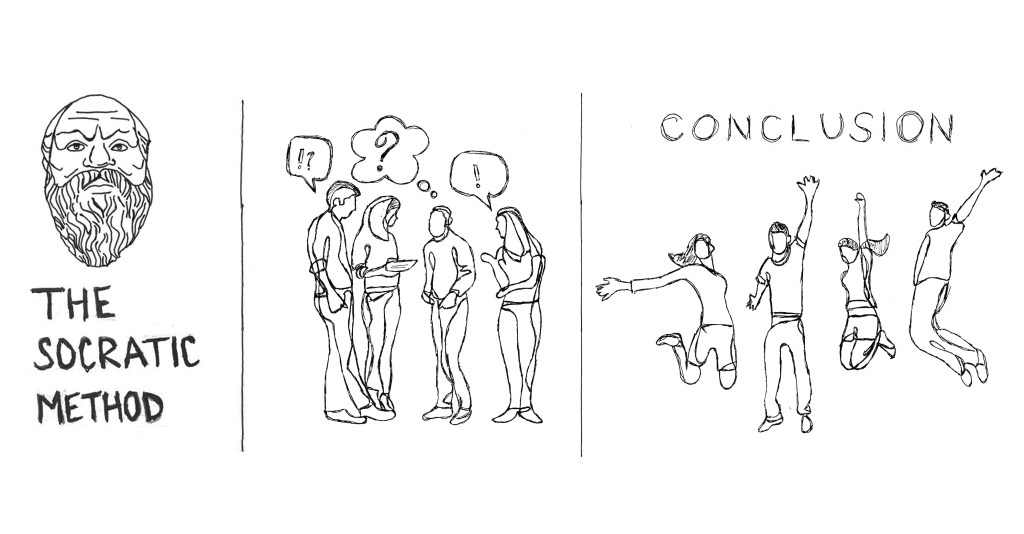
On a day in 399 BC the philosopher Socrates stood before a jury of 500 of his fellow Athenians accused of “refusing to recognize the gods recognized by the state” and of “corrupting the youth”. If found guilty; his penalty could be death. The trial took place in the heart of the city, the jurors seated on wooden benches surrounded by a crowd of spectators. Socrates’ accusers (three Athenian citizens) were allotted three hours to present their case, after which, the philosopher would have three hours to defend himself. The philosopher was taken to the near-by jail where his sentence would be carried out. Athenian law prescribed death by drinking a cup of poison hemlock. Socrates would be his own executioner.
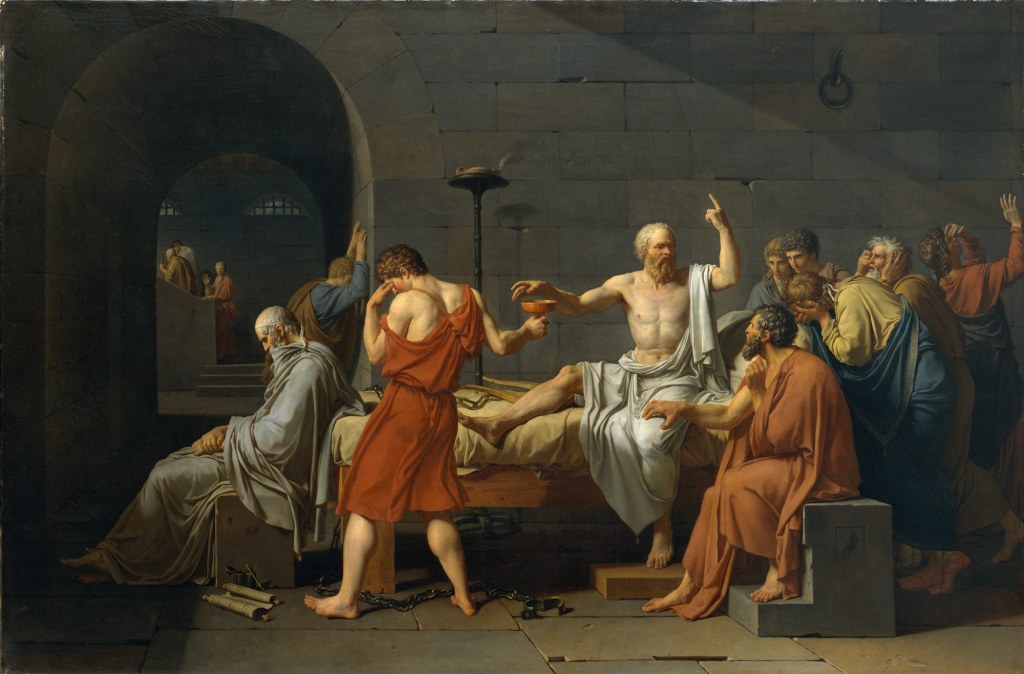
The Death of Socrates
Artist: Jacques Louis David (French, Paris 1748–1825 Brussels)
Date: 1787
Medium: Oil on canvas
Omar Mal
February 24, 2020
 Omar Mal