Critical Reflective Journal
Guest Lecture – Research Methods
This week’s lecture is by Martin Hosken. He imposed the question for this week: How do you approach research methodologies for your academic journey?
Let’s first explore the definition of the word research. In my opinion, it simply means investigating something in several methods. It really depends on various resources which have increased with the rise of technology and digital. According to the Oxford dictionary, research means “the systematic investigation into and study of materials and sources in order to establish facts and reach new conclusions.”
Again, other questions arise, whether research is a science, an art or a craft? Is it an academic exercise or an activity of life? Personally, I think research is a combination of all of these. It is a science because you need to go back to basics to find out answers. It is an art for the experienced and it’s a craft for the ones that have it as part of their jobs. It can also be both, an academic exercise and an activity of life. In real life, daily with the emergence of digital technology, we research people, companies, bloggers, products, services, etc. It has become part of our life due to the availability of data and the internet.
Curiosity for Knowledge
We are driven by curiosity. It is an innately human quality that has driven us to explore, ask questions, investigate, wonder why and search for a deeper understanding. In a very fundamental way curiosity is the driver of all self-directed learning. It is our desire to find out more, unlock new knowledge and answer our questions (big ones and little ones) that compels us to learn. The exercise of analyzing one’s room, brought to light many aspects that one never thought about before. It explored various elements that are always available in any room, but the questions asked evoked a sense of curiosity and played with one’s imagination.
Recently there has been debate about the place that curiosity plays in learning and its relationship with knowledge. The claim is that for a learner to ask quality questions about a field of knowledge they must first possess enough level of knowledge. It is reasonable to agree that a degree of knowledge is required before an individual is likely to arrive at meaningful questions that might drive an inquiry. Curiosity exists at the edge of knowledge. For this reason, even the wisest person has a point where the extent of their knowledge is reached; what they do at this point is what makes them wise. Rather than extinguishing curiosity, learning should shift the point at which we rely upon our curiosity ever deeper into our learning journeys and further from the point of what is known. Curiosity is the driver of learning for the novice and the expert.
Nature of Philosophy
According to Wikipedia, “Natural philosophy or philosophy of nature (from Latin philosophia naturalis) was the philosophical study of nature and the physical universe that was dominant before the development of modern science.” It is important to understand the nature of philosophy because philosophy touches so many subjects and, especially, because many of its methods can be used in any field. The study of philosophy helps us to enhance our ability to solve problems, our communication skills, our persuasive powers, and our writing skills. There are three specific areas of philosophical inquiry: metaphysics is concerned with questions about the nature of reality, epistemology is concerned with questions about the nature of knowledge, and axiology is concerned with questions about the nature of values. Rationalism in philosophy is the theory that reason rather than experience is the foundation of certainty in knowledge. (Oxford Dictionary)
Method vs. Methodology
While “method” and “methodology” are closely intertwined, they serve different roles in the research process and should be treated accordingly. A method is simply the tool used to answer your research questions — how you will go about collecting your data. A methodology is the rationale for the research approach, and the lens through which the analysis occurs. It describes the “general research strategy that outlines the way in which research is to be undertaken” (An Introduction to the Philosophy of Methodology, Howell 2013). The methodology should impact which method(s) for a research attempt are selected in order to generate the compelling data. Based on the industry I work in, which is advertising, I mostly use methods. For example, we usually get focus groups for interviews or conduct surveys to check out different ideas or concepts. On of the most common methods of gathering information or data is using questionnaires.
The basic principles of research ethics are minimizing the risk of harm; obtaining informed consent; protecting anonymity and confidentiality; avoiding deceptive practices; and providing the right to withdraw. Whilst ethical requirements in research can vary across countries, these are the basic principles of research ethics. This is important not only for ethical reasons, but also for practical ones, since a failure to meet such basic principles may lead to your research being criticised, potentially leading to a lower mark, and/or rejected by your supervisor or Ethics Committee, costing you valuable time.
Primary & Secondary Sources
In research, its important to distinguish between primary and secondary sources once collected. A primary source gives you direct access to the subject of your research. Some examples include archives and manuscript material; photographs, audio recordings, video recordings, films; journals, letters and diaries; speeches; scrapbooks; published books, newspapers and magazine clippings published at the time. While Secondary sources describe, summarize, or discuss information or details originally presented in another source. Examples are publications such as textbooks, magazine articles, book reviews, commentaries, and encyclopedias.
What makes a good research question?
The research question is one of the most important parts of your research project, thesis or dissertation. It’s important to spend some time assessing and refining your question before you get started. The exact form of your question will depend on the length of your project, the type of research, the topic, and the research problem. But all research questions should be focused, specific, appropriately complex, and relevant to a social or scholarly issue.
Literature review
“A literature review is a scholarly paper, which includes the current knowledge including substantive findings, as well as theoretical and methodological contributions to a particular topic. Literature reviews are secondary sources, and do not report new or original experimental work.” (Wikipedia) The basic components of a literature review include: a description of the publication; a summary of the publication’s main points; a discussion of gaps in research; an evaluation of the publication’s contribution to the topic. The lecture discussed the CRAAP test. This was the first time I hear about it. It basically is a set of evaluation criteria that can be applied to websites, articles, and other information sources to help you determine if the information is reliable. CRAAP is an acronym for Currency, Relevance, Authority, Accuracy, and Purpose.
Resources
Design Research: Methods and Perspectives, which Brenda Laurel has edited, features reflections and ruminations by 49 authors on techniques and experiences of undertaking research. The dominant focus of this publication is on the use of design research within the profession. It moves rapidly to its task of empowering designers into using research to enliven their work and build more effective client relationships. As a designer, my first thing after getting briefed is to research competition and see the concepts used. It helps me to investigate what is currently being used and not used and to scan the market before going to the drawing board. Once that is done, I can focus on brining my initial idea to life and provide my clients with the best possible concept option.
Creative Research: The Theory and Practice of Research for the Creative Industries by Hilary Collins, assesses how academic research methodologies must be adapted to suit the creative disciplines and industries and offers a guide to the process of undertaking a research project in this context. In creative contexts, a visual approach to research is often more appropriate. Again, based on my industry, I agree with this. Visual approaches are crucial to explore the concepts implemented. A designer does not want to reuse the same idea. A designer needs to explore other concepts within the same theme at hand.
While Noble and Bestley’s Visual Research: An Introduction to Research Methodologies in Graphic Design explains the value of ethical practice in research within the field of visual arts. It can be difficult to find good, clear examples that not only explain the theory but provide a useful framework from which one can begin to understand how to apply it. This book draws together a range of theoretical approaches and research methodologies related to the field and offers a practical application of the processes involved in visual research.
Reflection on Work
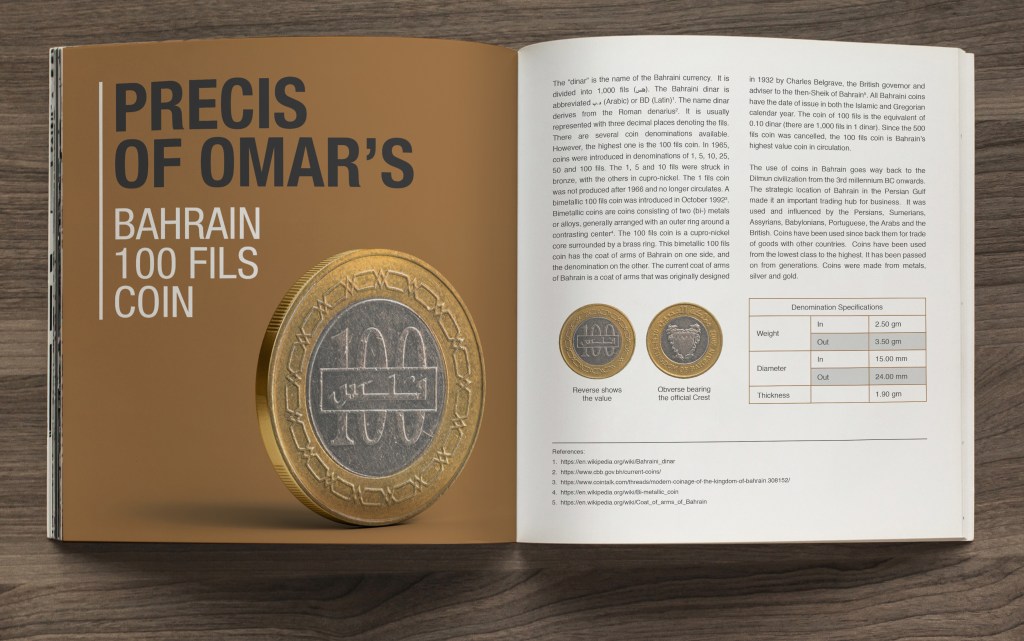
The Bahraini coins is something that is used daily. Its part of the Bahraini currency. The Kingdom of Bahrain is the place that I call home. Thinking about the unnoticed from last week’s challenge got me inspired to investigate the country’s coins. Specifically, I would like to focus on the 100 fils coin which has the highest value in circulation. The 500 fils coin was cancelled back in 2011. The history of Bahrain has many civilizations like Dilmun. From the fourth millennium to 800 BC, Dilmun was a significant trading center controlling the trading routes in the Gulf. Dilmun is mentioned in many other civilizations as a trade partner, or as the place where fine goods come from. Hence, coins were used since back then.
Workshop Challenge
Omar Mal
March 9, 2020
 Omar Mal