Finding the Gaps
This week’s lecture is a series of talking heads case studies, asking of a variety of practitioners the following two questions:
What would you like to be doing that you are not doing in your work?
It was interesting watching the variety of practitioners were most of them are practically happy with what they are doing and would not want to do anything else or different. I mostly related to Simon Manchipp from Someone as I once owned my own agency with myfriend and the projects we handled came from different industries. There were new challenges everyday and this gives one a sense of pleasure and satisfaction as you are always on your feet thinking of new ideas and ways of solving the client’s problems. You get a sense of adrenaline and good stress out of this which makes you think smartly and creatively. Sometimes when things become piled up and long nights hit in, I have a wish that I would be doing something else. I always wanted to join the military and serve my country. However, circumstances did not help me to go towards that route. I am very satisfied with my profession, but humans always desire what they do not have.
How important are side projects and are you currently working on any?
Side projects were very important when I was studying my degree back in Lebanon. I was eager to take any side project in order to learn and practice new skills. I had a part-time job in the largest printing press at my area. After graduating and moving to the Kingdom of Bahrain, I would take side projects to make extra money on the side. These would include logo designs, e-invites, wedding invites, artist album covers and more. I had time when I owned my own agency. However, working in an international agency does not allow you to take side projects due to the work pressure and long nights. Also, most of the agencies have a policy that does not allow designers to work on projects not related to the agency. Side projects are convenient if they are on a small scale. Long projects consume a lot of time and can add to the current workload pressure.
Resources Reflection
BBC Click’s Spencer Kelly finds out the history behind Brian Eno’s legendary Oblique Strategies cards, used by artistes to cure creative block. I totally agree with Brain Eno when he talked about being in the moment of panic and anxiety that you forget all your good ideas and observations. You are submerged in that moment of panic in order to deliver. I really like the idea of these creative block cards and I was wondering if I should order them if available.
Brian Eno On Creative Potential was another interesting watch. He mentions that not all people are born equal in terms of creativity. Yes, I do agree that the very creative artists are considered even geniuses because they were born with this talent. However, I disagree about the point he mentioned regarding find an income/job. I think if you are creative and talented then you should use that to your advantage and make a source of income out of it. Everybody needs to be making a living to survive. Our world was much tougher than the times of Picasso or Rembrandt. Ideally, it would be great if you love what you do so that you can enjoy your job.
In the Importance of Vulnerability, we often imagine that what will win us friends and esteem is strength. But surprisingly, it’s vulnerability that’s at the core of friendship and likeability. This is an invitation to make friends with one’s own weaknesses. It’s important to be vulnerable because doing so allows us to share those things which have hurt us and feel compassion in the act of sharing. And the same vulnerability allows us to experience great new avenues of thought. Being vulnerable helps us ask for what we want and avoid stonewalling (shutting down or distancing ourselves from a partner). It allows us to build trust in others and to become fully engaged in an intimate relationship. Being vulnerable allows us to open our heart — to give and receive love fully.
In Keep Going, a big reason we give up on projects is the perfectionist belief that it all must be right on day one. That’s nonsense: we just have to keep faith, work one day at a time – and we’ll get there. Perfectionism is a belief that perfection can and should be attained. Nothing is wrong with being a perfectionist only that we need to investigate “perfection” in a subtle way, not sacrificing ourselves and our health conditions. How can a designer be a perfectionist? Setting a high personal standard would make your work on top of what others expected. This will make you achieve a better output and will surely impress your clients. A perfectionist usually works with a certain process and they always see to it that everything is organized. Being systematic is a way to maximize your time. There are various perspectives as to what a “perfect output” is. Normally, one would be satisfied with their work when it comes out the way they want it or better than they want it. Little details that most designers might overlook could be noticed by a perfectionist. Perfectionists not only want their work to be polished, but they also want it to be different from the work of other designers. You will certainly think outside the box. Once you post a challenge for yourself, you’ll always work for the better. You always try to beat the challenges that you have placed making you a better and more empowered designer. No matter how long the queue of workloads you have, you will always aim for the best in every project you are working on. On whatever project you are working on, you should always satisfy yourself before you satisfy others. It will also help build self-confidence and self-reliance which are very important for designers. And you don’t have to be a workaholic when you are a perfectionist. It really depends on how you handle yourself, but you’d better take a break occasionally and get some fresh air. It is easier to achieve perfection when your mind is relaxed.
Workshop Challenge
The Challenge: Mind the Gap
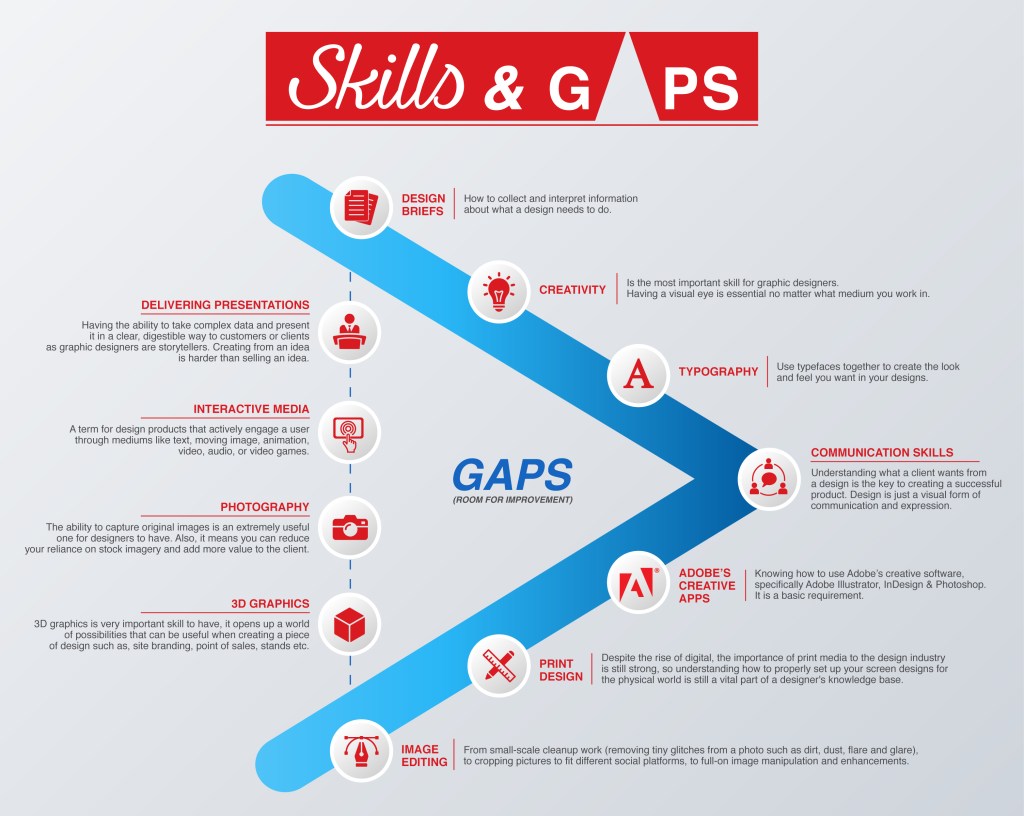
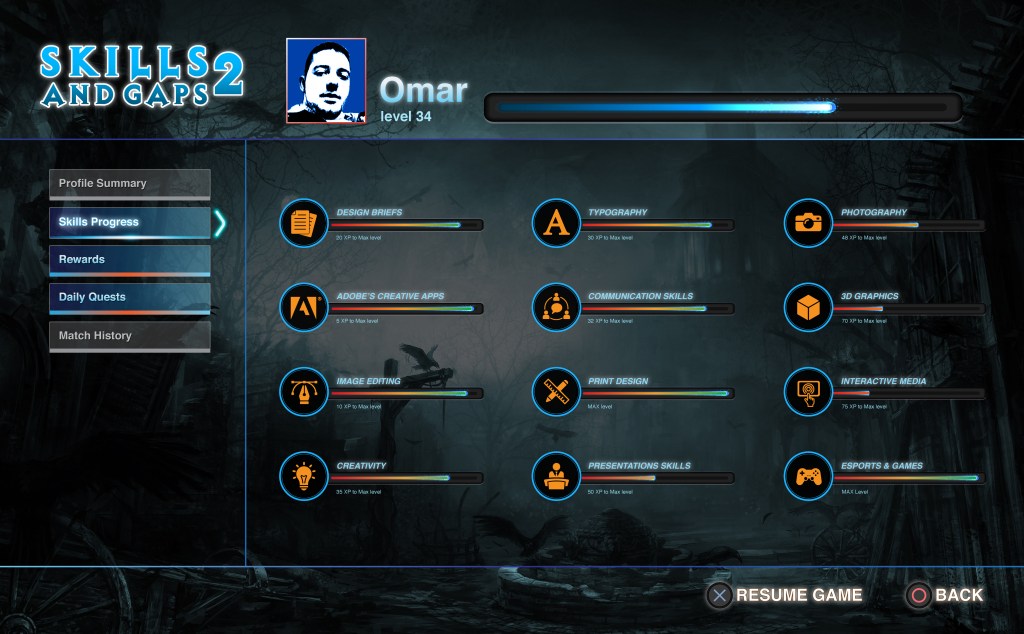
For the creative minded, graphic design jobs can be stimulating, fun, and potentially lucrative. Here is a list of my skills as a Senior Graphic Designer: creativity, typography, Adobe Creative Apps, branding, image Editing, design briefs (researching and conceptualizing), print Design.
It is essential for a designer to continue developing his/her professional skills as the role is continuously changing with the demands of digital. Here is a list of my developing skills or gaps I need to work on: photography, interactive media (including animations), delivering presentations, 3D graphics.
Since I have a huge interest in Esports events, gaming and Twitch Live Streaming, I have decided to make my diagram to look like a video game menu interface.
Omar Mal
March 16, 2020
 Omar Mal