Comparing Different Case Studies, Media Use and Equity Ownership

Copyright law is the law that protects creative work from unauthorized copying and usage. Illustrations, photographs, and graphic design that users reproduce and exploit for commercial purposes without the permission of the owner or designer is a clear violation of this law. Here’s a list of some things you can’t copyright ideas, systems, methods; names, titles; slogans, expressions, or short phrases; symbols, measuring charts, calendars; letters or color variations; and Fashion. However, trademarks can protect these. The difference is that copyright protects literary and artistic works such as videos, music, and books. While a trademark protects logos and other artwork that defines a company’s brand.
Once an original artwork is created, the current copyright law automatically protects it, without undergoing the registration process. The author or owner of the artwork has the right, by default, to decide who can use, copy, or reproduce it under conditions set by them.
However, if you still want to have the capability of suing unauthorized users and make a claim for copyright infringement, you must have the work copyrighted.
So, who’s owns the copyright ownership between in an agency-client relationship? The graphic designer who creates the artwork is automatically considered as the “author” and the owner of the copyright as stated under the law. However, as the client, you get to own the copyright of the work a graphic designer creates within the scope of his full-time employment. If you hired an independent contractor, they should assign the copyrights to you through a legal contract between both parties in exchange for the remuneration that you agreed upon. However, the artist is only prohibited to use the artwork elsewhere, but they can claim it as their creation.
Copyright infringement is taking your artwork, or a substantial part of it, without asking for your permission. Each country has their own set standards of what constitutes a substantial part. Fair use in copyright is when the artwork is used, without asking for the owner’s permission. It’s applicable for non-commercial, transformative, educational, and parody purposes only.
Copyright is automatic but there are a lot of benefits in registering your artwork as copyrighted. You can claim for damages or compensation should unauthorized people use your artwork. If you have not registered your work, there are still some things you can do to prove that it is yours. You should have records of your original artwork, dates of publication, even witnesses to prove your ownership. You then must prove that there is a connection between your artwork and the copied version of it for you to seek compensation.
In the Middle East, these things are not taken very seriously. In Bahrain, there are two clear examples of trademark issues such as Younis Burger and Jasmi’s.
Younis Burger in the Kingdom of Bahrain is a local burger restaurant that did not spend much time creating a unique identity for itself. It basically copied the international brand of Carl’s Junior or Hardee’s. There’s no difference between Carl’s Junior and Hardee’s – Hardee’s is the East Coast equivalent of Carl’s Jr. … Hardee’s is a fixture in the South, Mid-Atlantic, and Midwest. Carl’s Jr. is big in the West. They use the same branding — the distinctive red-and-yellow color scheme and that zippy little star logo.
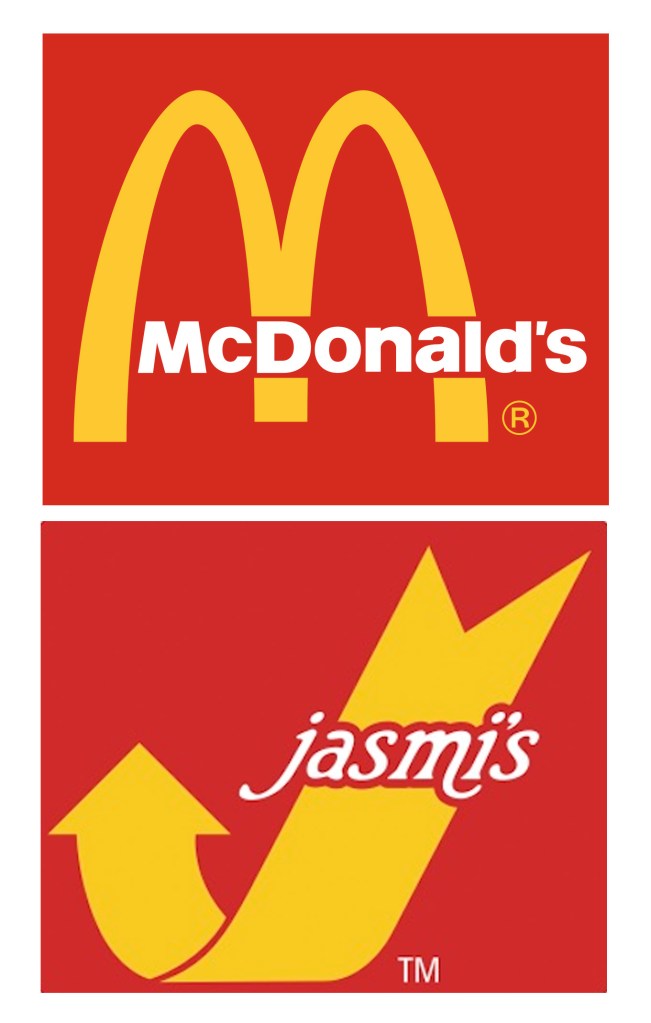
Another fast food example in Bahrain is Jasmi’s local favorite burger chain. This brand is copy-paste from the global McDonald’s brand. Like the famous M, this local brand emphasizes on the letter J. This brand has grown with the generations of Bahrain and is an all-time favorite. Further to that, once McDonald’s in Bahrain introduced their Breakfast and McCafe menus, it copied with similar product offerings.
In 1986, a University graduate, Jassim Al Ameen, conceptualized and developed his formula for fast food business in Bahrain. Coined from his own name, he formed the Jasmi’s Corporation WLL serving a wide variety of quick-served foods at reasonable prices.

Week 3 – Workshop Challenge
Saudi Telecom’s New Corporate Identity
STC Group, is Saudi Arabia’s incumbent operator. It operates in Kuwait, Kingdom of Bahrain, Turkey, South Africa, India, Indonesia and Malaysia. stc Bahrain, a subsidiary of stc Group, is the fastest-growing, most innovative telecommunication operator in Bahrain. Since its inception in 2010, stc Bahrain revolutionized the telecommunications industry in the Kingdom of Bahrain and quickly became a market leader, a position that it kept to this day through investing in next-generation technologies and introducing innovative solutions to the people of Bahrain.
In December 2019, VIVA Bahrain announced a change of its corporate identity to stc Bahrain. The new identity was unveiled at a special launch event attended by stc Bahrain employees, as well as the media professionals and social media influencers.
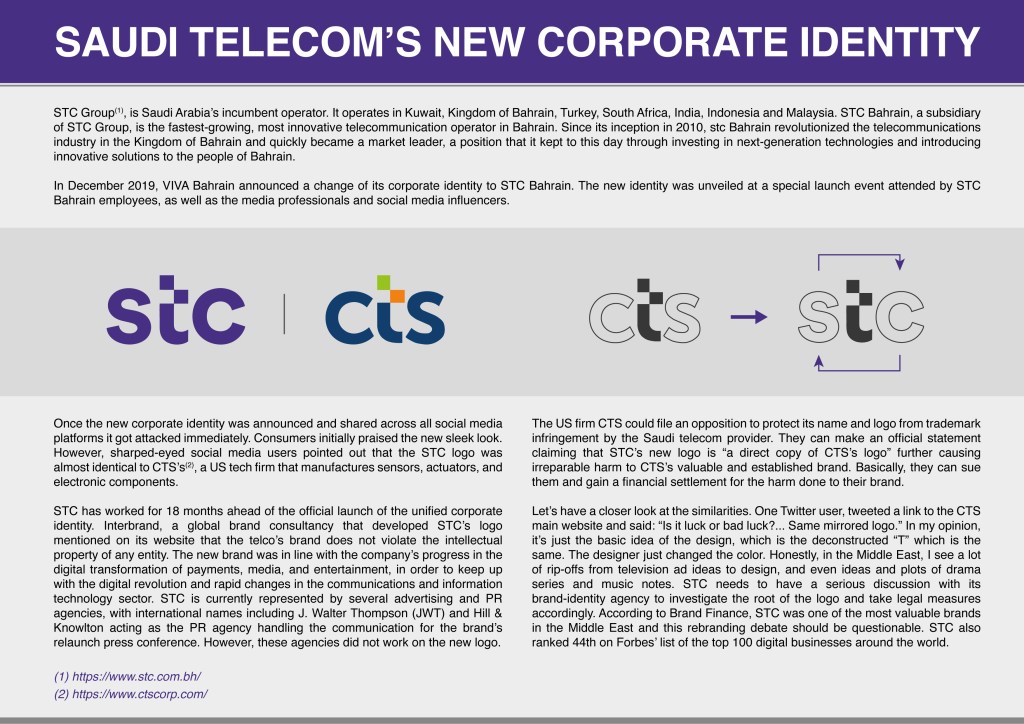
Once the new corporate identity was announced and shared across all social media platforms it got attacked immediately. Consumers initially praised the new sleek look. However, sharped-eyed social media users pointed out that the STC logo was almost identical to CTS’s, a US tech firm that manufactures sensors, actuators, and electronic components.
STC has worked for 18 months ahead of the official launch of the unified corporate identity. Interbrand, a global brand consultancy that developed STC’s logo mentioned on its website that the telco’s brand does not violate the intellectual property of any entity. The new brand was in line with the company’s progress in the digital transformation of payments, media, and entertainment, in order to keep up with the digital revolution and rapid changes in the communications and information technology sector. STC is currently represented by several advertising and PR agencies, with international names including J. Walter Thompson (JWT) and Hill & Knowlton acting as the PR agency handling the communication for the brand’s relaunch press conference. However, these agencies did not work on the new logo.
The US firm CTS could file an opposition to protect its name and logo from trademark infringement by the Saudi telecom provider. They can make an official statement claiming that STC’s new logo is “a direct copy of CTS’s logo” further causing irreparable harm to CTS’s valuable and established brand. Basically, they can sue them and gain a financial settlement for the harm done to their brand.
Let’s have a closer look at the similarities. One Twitter user, tweeted a link to the CTS main website and said: “Is it luck or bad luck?… Same mirrored logo.” In my opinion, it’s just the basic idea of the design, which is the deconstructed “T” which is the same. The designer just changed the color. Honestly, in the Middle East, I see a lot of rip-offs from television ad ideas to design, and even ideas and plots of drama series and music notes. STC needs to have a serious discussion with its brand-identity agency to investigate the root of the logo and take legal measures accordingly. According to Brand Finance, STC was one of the most valuable brands in the Middle East and this rebranding debate should be questionable. STC also ranked 44th on Forbes’ list of the top 100 digital businesses around the world.
Omar Mal
June 16, 2020
 Omar Mal