Reflecting on Classic Models for Graphic Design Working
Working in collaboration helps designers understand how inter-team members work together and their needs, pain points, and preferences. We can be in a better position to empathize and understand different viewpoints to ensure a seamless transition of deliverables. As designers, we focus on ensuring that our designs match the needs of users and solve their pain-points while keeping the business goals in mind. It is important for us to understand the bigger picture and not get stuck within the processes to find perfection in our design. Over the years, I’ve come to learn that designing collaboratively means putting your egos aside to make something that transcends the sum of its creators.
Working in collaboration with different internal teams gives designers the opportunity to understand exactly how they work together in sync to ensure the successful completion of the assignment at hand. Amongst the skills you should have to be a successful designer, understanding the functioning of inter-teams is an important one. Effective team collaboration can encourage peers to take complete ownership of their work and lead design deliverables. Designers can be motivated to take responsibilities and communicate their thought process independently to clients and stakeholders.
One of the must-have soft skills for creative professionals is proper communication. Team collaborations can help designers be very constructive while communicating ideas, important decisions and sharing their thought process with peers. Thus, we can also ensure an encouraging environment during constructive design critique sessions. Working in sync with inter and intra-team members, help us empathize with their needs, involve them during important discussions, make us comfortable to reach out to each other for any assistance desired. A positive environment like this helps to instill trust in teams and build an amazing culture. Together, the contribution of a team is always more valuable than an individual contribution. Every successful project engagement is a result of an amazing team effort. Helping each other at work ensures that we all gain knowledge, become better day by day, grow by giving equal opportunity to everyone to lead and learn.
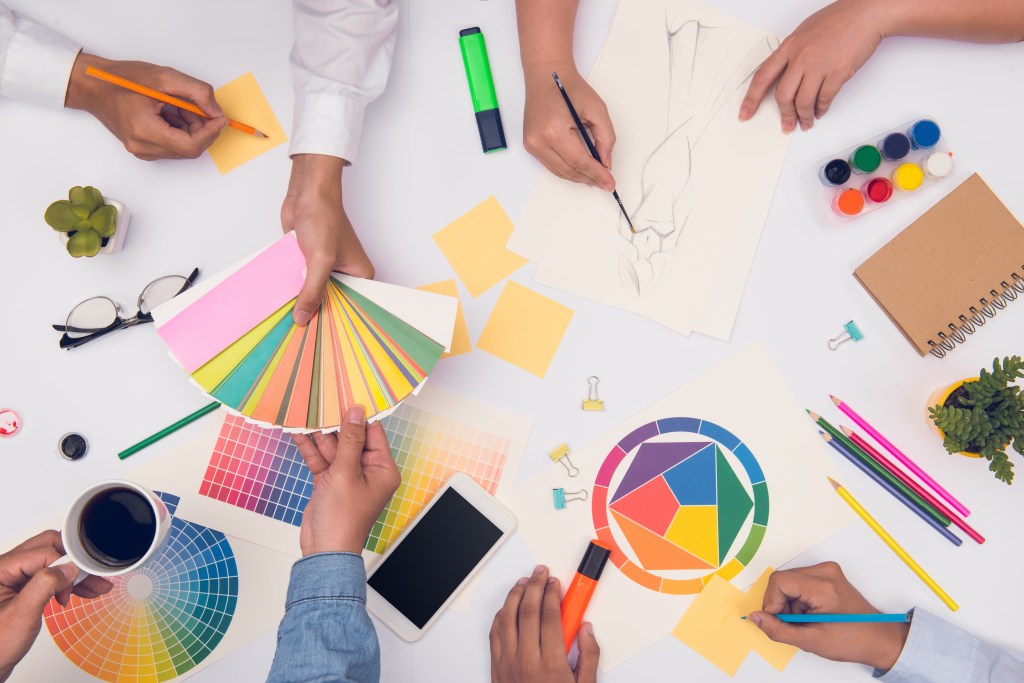
It is quite amazing to think that all the people working on the project work towards the same goal, irrespective of the team they belong to. When everyone has a common, unified goal, any vision can be achieved, and benefits can be distributed to the team members. Excellent team collaboration within internal and external teams can help to achieve revenue goals as well. In design studios, communication and collaboration between co-designers rely as much on different visual and physical aspects as they do on verbal aspects. During a typical collaborative design session, the type of information that is communicated between designers is multimodal, multisensory, ubiquitous and touches the artistic, emotional and experiential side of the designers’ thinking, in addition to their instrumental and practical reasoning. In order to better support designers’ work and to develop new collaborative technologies, we need to understand how collaborative practices of designers enable creativity in their everyday work. Moreover, in design studios, much of design work is collaborative and group-oriented and the physical nature of design studios can easily afford group-orientation and collaborations. Overall, the physical setting of the design studio is typically meant to emphasize and stimulate communication, collaboration and sharing. The spatial aspects of design studios promote a style of learning that is based on continuous dialogue, conversation and critiquing on each other’s work.
There are famous examples of collaborations in marketing between big brands. Both Uber and Spotify started as revolutionary apps, fulfilling problems that had plagued the industry for years. This collaboration made use of the fact that they were offering complementary services, allowing them to tap onto each other’s customer base at the same time. As they were both popular tech start-ups, the collaboration also generated a huge amount of hype in the tech world, giving them free publicity and media buzz. It introduced tons of uber users to Spotify, while providing Uber users with an even more personalised and unique experience and appeared on many best-of lists for collaborations.
To conclude, I believe that the key to great collaboration is building great relationships and ensuring the effective acquisition of soft skills for designers. This leads to synchronized team efforts and long-lasting trust and relationships between the company and the clients.
Week 5 – Workshop Challenge

For this week’s challenge, I’ve decided to showcase a collaboration between a telecoms company, a rapper, and graffiti artists to launch a campaign targeted towards the youth segment.
This specific campaign came to mind as I have worked for the Zain Account since 2007 for around 6 years with two different agencies. At that time, it was the top brand for the youth segment. The Zain brand is known for launching out of the box ideas and engaging with its youth segment. For this campaign (launched in Q1 2016), it collaborated with various artists to deliver on a powerful campaign that was the talk of town. The collaborations turned out to be a huge success and delivered on engaging the youth segment in various ways that were relevant and unconventional.
Omar Mal
June 30, 2020
 Omar Mal