According to toppr.com, an entrepreneur is a person who undertakes a venture with some profit potential and involving a considerable amount of risk and therefore, entrepreneurship is the venture undertaken by the entrepreneur. The most obvious example of entrepreneurship is the starting of a new business. Entrepreneurship can be of varying degrees and is not necessarily alike. It can be categorized into various subcategories, starting with small and home businesses to multidimensional industries that were started from the ground level.

But not all entrepreneurs are successful. There are certain characteristics of entrepreneurship that make for a successful venture. There are some characteristics that are considered indispensable or necessary in an entrepreneur.
1. Ability to take Risks
This is the first and foremost trait of entrepreneurship. Starting any business involves a considerable amount of risk of failure. Therefore, the courage and capacity to take the said risk are essential for an entrepreneur.
2. Innovation
In a world, where almost everything has been done, innovation is a priceless gift to have. Innovation basically means generating a new idea with which you can start a business and achieve a substantial amount of profits. Innovation can be in the form of a product, i.e., launching a product that no one is selling in the market. It can also be in the form of process, i.e., doing the same work in a more efficient and economical way.
3. Visionary
Every entrepreneur needs to be a visionary. Without a vision for the future of his venture, he or she would just be working aimlessly without reaching any point of success.
4. Leadership
An entrepreneur has a vision. However, it takes a lot of resources to turn that vision into reality. One of these resources are the people that the entrepreneur hires to perform various functions like production, supplying, accounting, etc. A single person cannot perform all the tasks and therefore it is important to bring some more people to do it. This also makes leadership very important as a leader provides the required direction to the efforts of the employees. Without proper leadership, everyone would be working independently without achieving the desired results.
5. Open Minded
A good entrepreneur realizes that every situation can be a business opportunity. Thus, can be utilized for the benefit of the organization.
6. Confident and Well Informed
An entrepreneur needs to be confident about his ideas and skills. This confidence also inspires the confidence of the people working for him as well as the other stakeholders involved in his business. This confidence comes from being well informed about the industry and environment. Various legal and political policies enhance business and trade opportunities, while some hinder them. Having knowledge about these can really help an entrepreneur make the right decision at the right time.

According to Grin.com, Johan Wempe says ethical entrepreneurship, in a nutshell, amounts to the achievement of ethical goals through entrepreneurship. In simple terms, the implication of ethics to entrepreneurship is known as ethical entrepreneurship. Ethical principles have always increased the value of the business. It helps the business in retaining good employees and creates a positive environment for the business.
Characteristics of Ethical Entrepreneurship:
Measured risk: Entrepreneurs are risk takers, staking money, time, and personal reputations to manifest their visions. But, like heroes, entrepreneurs are rarely reckless. Rather, successful entrepreneurs take measured risks, weighing the stakes and the potential consequences, and then stepping into unknown territories to generate results. As risk takers successful entrepreneurs understand that failure can be a vital part of success, and that learning from mistakes can be a way of reaping benefits from situations that might otherwise feel like failures.
Physical responsibility: Businesses run on money, so entrepreneurs must have a solid sense of how to raise and manage funds. Successful entrepreneurs have an intuitive sense of how much money they will need to run their companies, but they supplement this sense with concentrate documentation and calculations to migrate uncertainties. Entrepreneurs are willing to risk money by making investments in building their businesses, but they keep a close eye on the numbers in order to understand how much they are spending and whether their expenditures are bringing about the desired results.
Creativity: Starting a business is a creative endeavor that starts with conceptualizing a product or service, and then building a practical infrastructure that can sustain itself while delivering that product or service. Entrepreneurship requires creative problem solving as well as creative product development, and entrepreneurs have the creative freedom to think outside the box and develop unique strategies that balance personal values with practical constraints.
Management skills: Successful entrepreneurs see the big picture. They have the skills and the humanity to define their own role in company operations, and the interpersonal skills to successfully delegate the tasks they can’t complete themselves. Successful entrepreneurs are successful managers, sharing the company’s vision and clearly communicating the ways that his vision is infused into mundane daily tasks. An entrepreneur’s management skills come into play in the process of carefully choosing employees, and these skills carry over into careful training, as well as the daily challenges of motivating and organizing workers.
The problem with entrepreneurs is that either they micromanage or over delegate. Both these attitudes are harmful in the long run. When the going is good, everything seems to be fine. But when the downfall begins, entrepreneur starts feeling the pinch. Good ethical behavior also helps entrepreneurs to develop good relations with everyone in the business during the initial period of establishing the business. Reputation for meeting one’s commitment also helps entrepreneurs to win customers. While an entrepreneur may or may not have very high ethical standards, a bad reputation for flouting norms of ethical behavior is anathema for an entrepreneur trying to establish a new business.
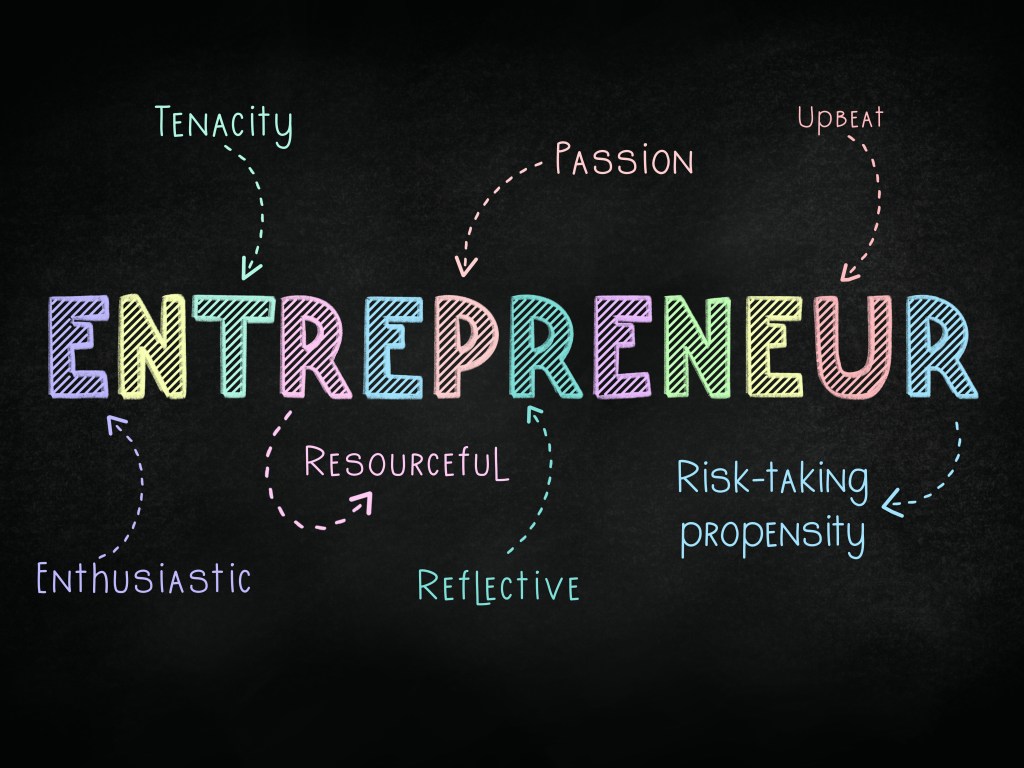
In my opinion, the key characteristics of an entrepreneur today are:
Passion: If you have passion for your startup, this will drive you to turn your idea into a reality. Without that missing spark, you’ll lack the necessary motivation to put in all the early mornings and late nights to get your business off the ground.
Perseverance: Entrepreneurs need to be able to deal with obstacles. A business does not get built overnight and turning your idea into a reality will take time. You’ll have to become accustomed to people saying no to you. What makes entrepreneurs great is having the perseverance to grow regardless of how many times they are shut down.
Resourcefulness. A vital ability for an entrepreneur is knowing how to make the most of what you have. Your assets as an entrepreneur will be limited, so use them to the fullest. Tapping into a network is key.
Open-Mindedness. As an entrepreneur, you may think you’ve zeroed in on a business plan, but you’ll need to learn to take in the opinions of others. Then if it appears that your plan won’t work, then adjust.
Sponge-like nature. Being an entrepreneur involves a learning process. If you’re not willing to learn, think about leaving the startup world. You need to be able to soak in everything and anything you can, just like a sponge. The more you learn, the better.
Workshop Challenge
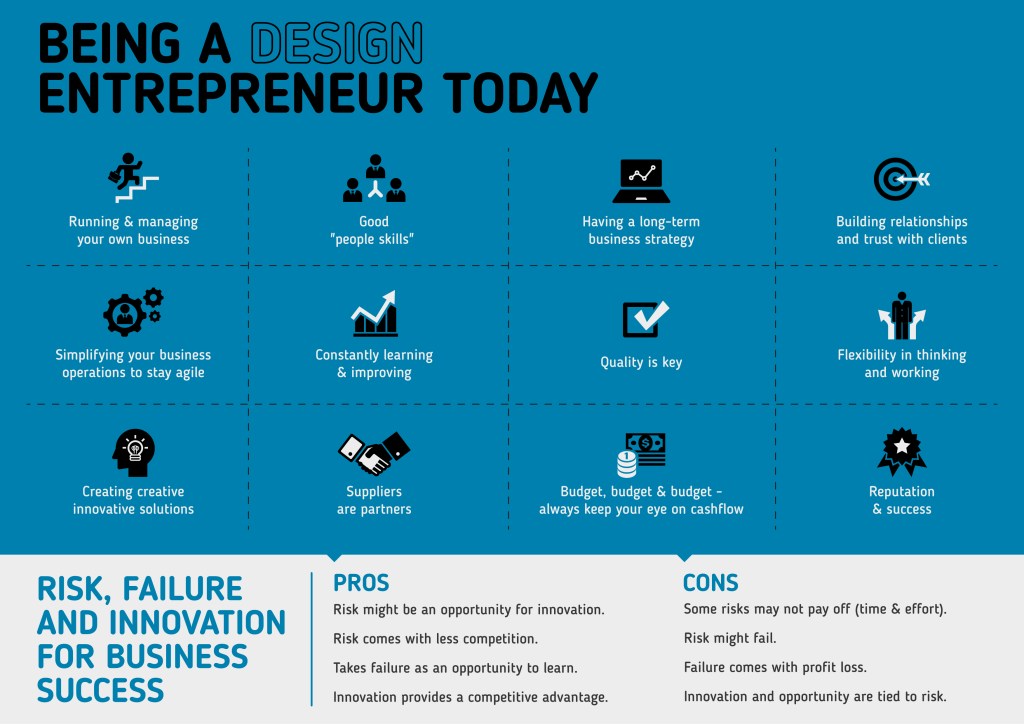
Successful entrepreneurship involves taking risks. Taking risks, however, does not mean going into business blindly and then expecting great results. Taking risks in entrepreneurship involves careful planning and hard work. Nobody can really be sure if risks will pay off, no matter how calculated they may be. But this should not stop you from taking risks. If you want your business to succeed, risks are necessary.
Some risks may not pay off, but an optimistic risk-taker will always look at failure as an opportunity to learn. Failure will teach you how to think and plan strategically. Just remember that not all risks are good ones, and when you fail, learn from it and move on.
Innovation involves changing how people do things. Combine that with the fact that customers have constantly changing demands and you have consistent opportunities for new business. It is about sharing and teaching what we know and putting new ideas into practice as a constant state of progress. Business leaders accept risk as a cost of opportunity and innovation. They know it cannot happen if you will not accept the risk that your undertaking might fail. The level of risk may be lessened, however, if you make all possible calculations and evaluate which options are best before proceeding to the next step.
Since most people tend to avoid risk, those who are brave enough to take risks already have a competitive advantage. This means if you’ve found a worthwhile opportunity, and no one else has jumped on it, you’re the only business reaping the benefits and communicating with customers. So anytime you’re considering taking a risk, keep your competitors in mind. If you don’t take the risk, they may opt to do so instead. But if you understand the potential return, you can rest assured knowing whether it’s a worthwhile risk or not.
Most people are not willing to take risks, but a study revealed that there is a link between willingness to take risks and personal satisfaction. Instead, you know what was on the other side of that “what-if” scenario and can feel proud of the fact that you were willing to take risks to grow your business.
Now again this doesn’t mean you take risks at every turn but instead take calculated risks that have been thoroughly considered. Avoiding unnecessary risks and saying no to new ones based on past experiences can be just as satisfying. Finding the right balance and taking risks when it makes sense, even if there’s a chance of failure, is a sure way to find success and satisfaction.
Taking risks is closely linked with entrepreneurship. You may be leaving a steady-paying job, risking your reputation with new products, and adding financial risk with a loan or investment. On top of that, there are risks involved in hiring employees, marketing strategies, and even customer service. Instead of being discouraged or aimlessly moving forward, you can instead work as a calculated risk-taker, who carefully take steps toward your goals. Risk is inevitable, but by understanding that you can find ways to reduce unnecessary risk in your business and develop a risk management plan.
Subjective norms have influence on entrepreneurial behavior due to unemployment and family commitment. Expectations of family and friends influence an individual for entrepreneurial behavior (Kennedy et. al. 2003). Family plays an essential role for economic activity for the creation of firms and their growth. Family represents the important part of culture and has the significant impact on the performance of its members. Moreover, family provides opportunities to its members to develop networking. Traditional families play important roles in business and society because of the stronger ties and relationships for the enhancement of business, for maintaining their position in society and to maintain their power as well (Steier 2004). Peer group is the main source for social interaction as well as to develop entrepreneurial intention. Peers help in developing entrepreneurial knowledge and skills by sharing, learning and exchanging the information about entrepreneurship programs, events, and resources of learning when they participate in meetings and associations in and across the educational institutions.
To determine the entrepreneurial intention, it is very important to study the culture. Social values and beliefs concerning about entrepreneurship have an effect on the motivational background of intention, on the other hand skills are also important factor for entrepreneurial intention. Individuals who have entrepreneurial skills are more prone to adopt entrepreneurship than those who do not have those skills (Linan 2009). Family commitment, expectations of family and friends influence individual for developing entrepreneurial behavior. Economic disparities having relatively distinct cultural composition also affect the entrepreneurial behavior. Education helps entrepreneurs in increasing its focus on creativity and confidence-building.
Entrepreneurial intention is the way to create new firms within available resources. Entrepreneurial intention is based on cultural and environmental factors in which individual live. Young people are more prone to adopt entrepreneurship as career choice as it is the way for social and economic development and to meet the expectations and demands of the environment in which they live (Aghazamani and Roozikhah 2010). Entrepreneurs are those who have personality traits and intention to start a new business while innovation is a tool to enhance their business (Ahmed et al. 2010). A person is surrounded by social, economical and cultural factors which affects on the entrepreneurial intention and helps in enhancing self-confidence, risk-taking ability and innovation (Turker and Selcuk 2009). Decision to become entrepreneur based on ones’ personal attitude and the social pressure. Social values and beliefs concerning about entrepreneurship have an influence on the motivational background of intention (Linan 2008). Culture favorability has direct link to risk taking behavior of entrepreneurs in promotion of innovation and activity (Aghazamani and Roozikhah 2010).
Entrepreneurial intention is influenced by the socialization process, social networking and the environment while parental support, opinion and modeling having greater impact on entrepreneurial behavior (Linan et. al. 2009). Cultural values and the norms across the culture influences entrepreneurial activity within that country or region (Morris and Schindebutte 2005). National culture impacts on entrepreneurial behavior through the cultural values which are the essential part of society. Researchers show that there is a link between national culture and entrepreneurial activity and how culture impact on entrepreneurial behavior. Institutions are the key dimensions for entrepreneurship through risk taking, innovation and pro activeness. Individuals are more ambitious and willing to take risks and strong decision power to take immediate actions (Kreiser 2010).
A person is surrounded by cultural, social, economical and cultural factors which affects on the entrepreneurial intention and helps in enhancing self-confidence, risk-taking ability and innovation. Education has significant affect on entrepreneurial intention (Turker and Selcuk 2009). Family as unit of socio-cultural activities provides plate form for initiating economic activity for the creation of firms and growth. Family represents the important part of culture and has the significant impact on the firm performance (Steier 2004). Family business has greater influence on entrepreneurial intention because family has a greater role in career choice. Family business has stronger awareness of its impacts on new generation who want to become entrepreneur. (Carr et. al. 2007) Peers and friends played an important part as role model. Peers have a greater role in influencing one’s decision to become entrepreneurs (Keat 2011). Subsequently, depending on the country’s wealth, the culture can have a positive or negative effect on entrepreneurial activity.
Omar Mal
July 27, 2020
 Omar Mal