Lecture – Competitive Context
After listening to the Competitive Context interviews, I do agree that sometimes you should investigate new opportunities for projects but not necessarily within your area of interest. This sparks a challenge in everything as you are out of your comfort zone. Unlike the self-initiated project, which comes from an area of interest. The industrial project is identified by the client or brand marketing director or product owner, and hence must solve a specific problem. Also, there are various competitors in the same market which makes it even more challenging. Every now and then, designers need to pursue new challenges and gain new knowledge to refresh their ways of thinking and coming up with creative concepts. Having a fresh eye and point of view of thinking presents new opportunities, challenges and rewards. Pursuing new opportunities as a designer is not a work of one single person. There must be collaboration between agency members from different departments to aid in working on the project. From the project managers team, to client servicing, to planning and research teams; all these need to work together to achieve delivering on the project in hand.

According to EuroMonitor, Marketing Research Blog, it discussed 8 ways to identify new opportunities. In today’s business environment, sustaining growth and profitability is never a guarantee. Technological and scientific advances shorten life cycles of products and services, business models change, and new competitors appear from outside the industry. This constant instability makes it necessary to seek new business opportunities. In order to identify market opportunities, the business model must be evaluated by identifying consumers and companies and other factors such as brand value propositions, direct and indirect competitors, supply chains, existing regulations and the general environment.
Consumer segmentation
To understand your demand, you must identify consumer segments that share common characteristics. These characteristics can be “hard” variables such as age, gender, place of residence, educational level, occupation and level of income or “soft” variables such as lifestyle, attitude, values and purchasing motivations. Hard variables can help estimate the number of potential customers a business can have.
Purchase situation analysis
Purchase situations must also be examined to uncover expansion opportunities. Questions to ask when reviewing purchase analysis are:
– When do people buy our product or service?
– Is it when they need it?
– Where do people make the purchase?
– How do they pay?
Looking at distribution channels, payment methods and all other circumstances that involve purchasing decisions can teach you how consumers buy and how you can position your product appropriately. Offering new shopping alternatives may bring new customers.
Direct competition analysis
In addition to analysing demand and purchasing situations, it is important to analyse supply. Knowing the existing players in the market where you are competing or going to compete is important when evaluating opportunities. Relevant questions in this case are:
– What are the products and brands of our industry that are growing more significantly and why?
– What is their value proposition?
– What competitive advantage do we have over them?
Indirect competition analysis
Opportunities can also be found by analysing substitute industries. This type of analysis helps establish competitive advantages against indirect competitors and provide insight on additional opportunities for growth.
Analysis of complementary products and services
Companies should monitor the performance of other companies’ products, which are complementary to their own. Trends in complementary markets should be considered when making investment decisions.
Analysis of other industries
In some cases, the objective of companies is not to continue operating within an industrial sector but to expand a certain business model or philosophy. In any case, to enter a new industry it is important to learn about competition first: market sizes, market shares, growth rates, unit prices, per capita sales and brands positioning.
Foreign markets analysis
When a company operates in a mature or saturated market, exploring other countries may lead to additional opportunities. Markets in different countries grow at different paces for several reasons, including disparities in the level of economic development and local habits.
Environment analysis
Market opportunities can also be identified by analysing changes in the environment with technological and scientific developments generating new business opportunities. Changes in a country’s regulatory framework can also create opportunities. Other transformations in the environment such as climate change, geopolitical movements and changes in financial markets also influence market opportunities.
Using a variety of analysis will help your business gain a holistic view of opportunities and help create long-term strategic business plans. Once opportunities are identified, companies must move quickly to create a plan. It is necessary to develop a value proposition, plan the commercialization chain and estimate costs, revenues, cash flows and financing needs. Not all market opportunities identified will succeed but experimenting will give answers on the potential of each.
(Source: https://blog.euromonitor.com/8-ways-identify-market-opportunities-business-growth/)
Preliminary Notes on Project Briefs:
Project 1: International Competition (Live)
Mental health awareness should not only be for a day or two or even a month. We must be informed about it because it can easily happen to someone close to us. Community awareness for mental health reduces stigma. Mental health awareness increases the chances of early intervention, which can result in a fast recovery. Some types of mental disorders include: Anxiety disorders, including panic disorder, obsessive-compulsive disorder, and phobias; Depression, bipolar disorder, and other mood disorders; Eating disorders; Personality disorders; Post-traumatic stress disorder; Psychotic disorders, including schizophrenia. Five Warning Signs of Mental Illness: Long-lasting sadness or irritability; Extremely high and low moods; Excessive fear, worry, or anxiety; Social withdrawal; Dramatic changes in eating or sleeping habits. May is Mental Health Awareness Month. Hosted by the Mental Health Foundation, Mental Health Awareness Week takes place from 18-24 May 2020. The theme is kindness.
I think now more than ever, it is important to address the topic of mental health worldwide as the pandemic has decreased our social gatherings and increased our worries and fears. This could happen to us or anyone within our close family circle. We must be aware of the signs and how we can fight this. This is a very interesting topic.
Project 2: International Competition (Concluded)
This brief is very interesting as well as it’s about my favorite brand: Adidas. I think the challenge to tackle the youth is great as they are the future generation. If I were to choose this brief, I would choose New York of London. I believe these cities are great to live in them but face the challenge of open spaces to perform any sport. The campaign could be about creating rooftop fields for youth to play sports while still being in the city. They play sports, have fun with their friends, and still be close to their schools and universities. Commuting takes time and these in proximity fields are the solution for their busy lives. In relation to products, the youth will be wearing full Adidas gear and showing the experience of using these fields.
Project 3: Live Collaboration
This brief is my favorite one. I would like to collaborate with the Nissan brand on this. They are into technology and innovation in the automotive industry. These are some of my passions. And this collaboration will result in the launch of something new in the market in Bahrain for the first time for this brand.
Project 4: Research & Development (Science Museum)
This brief is my least favorite in terms of interest. However, it’s a very challenging brief for whoever is interested in the subject. I think here a designer should apply digital and user experience skills into the design and thought process. It’s basically creating an easily searchable online archive of the collections.
Chosen Project
I would like to develop and deliver Project 3: Live Collaboration over the next eight weeks. I would like to collaborate with my client (the Nissan brand) and work on a new project in launching the first-ever electric SUV in the Kingdom of Bahrain. We shall work on this exciting project together. However, the launch will not take place until late 2021.
Creative Agencies of Competing Projects:
Tesla Motors has no advertising, no ad agency, no CMO, no dealer network. Elon Musk does all the storytelling and marketing is done via word of mouth.
The Hyundai brand is handled by Innocean Worldwide with its headquarters in Dubai for the middle east. http://www.innocean.com/ww-en/network/19
The Jaguar brand is handled by Spark44. https://spark44.com/about/
Competition Summary
All three competing industry professional project examples are in the automotive industry: Tesla’s Model Y; Jaguar I-Pace; and Hyundai’s Kona Electric.
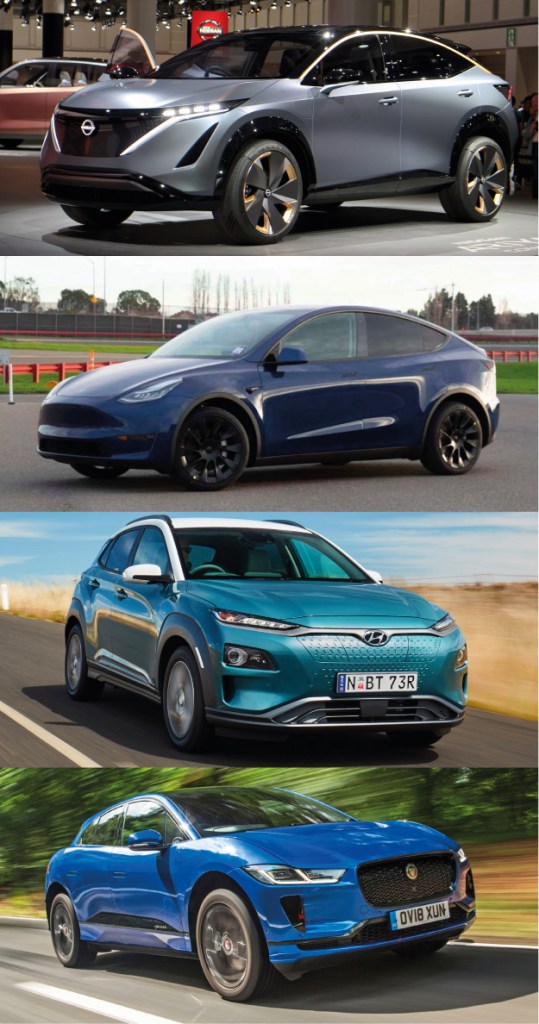
Model Y Tesla hasn’t been launched yet in Bahrain. Model Y is designed to be the safest vehicle in its class. The low center of gravity, rigid body structure, and large crumple zones provide unparalleled protection. Model Y provides maximum versatility—able to carry 7 passengers and their cargo. Tesla All-Wheel Drive has two ultra-responsive, independent electric motors that digitally control torque to the front and rear wheels—for far better handling, traction, and stability control. Model Y is capable in rain, snow, mud, and off-road. Model Y is fully electric, so you never need to visit a gas station again. If you charge overnight at home, you can wake up to a full battery every morning. And when you’re on the road, it’s easy to plug in along the way—at any public station or with the Tesla charging network. Model Y will have Full Self-Driving capability, enabling automatic driving on city streets and highways pending regulatory approval, as well as the ability to come to find you anywhere in a parking lot. With an elevated seating position and low dash, the driver has a commanding view of the road ahead. The interior of Model Y is simple and clean, with a 15-inch touch screen, an immersive sound system, and an expansive all-glass roof that creates extra headroom and provides a seamless view of the sky In terms of pricing, the new SUV is set to be priced at around $50K.
Jaguar I-Pace is the first all-electric performance SUV. Its electric motors and near-perfect weight distribution deliver 696Nm of instant torque and sports car agility. I‑PACE offers excitement from every angle thanks to its flowing waistline, dramatic bonnet scoop, and signature rear haunches. I‑PACE seamlessly integrates technology and abundant space. The interior design is clean and uncluttered, with tactile features and sweeping lines. I‑PACE’s Touch Pro Duo infotainment system makes it simple to control all the car’s technologies. 4G Wi-Fi capability1 is standard and a host of connectivity features mean it’s easy to keep in touch with your digital world. I‑PACE’s 90kWh battery is designed for longevity and supports protracted periods of sustained maximum power. The battery’s position within the wheelbase provides the vehicle with a low center of gravity, naturally benefiting vehicle dynamics, making I‑PACE a true driver’s car. I‑PACE delivers all-surface, all-weather drivability. Power and torque response is immediate and the electric motors can adapt independently to the driver’s inputs, road surface conditions, and available grip. I‑PACE’s highly efficient heat pump harvests heat from the outside air and electronic components of the vehicle. The warmth is transferred to the cabin via the heating and ventilation system, reducing the power demand from the battery while maximizing range. In terms of pricing, the Jaguar I-Pace is around $70K which is the most expensive so far.
Hyundai’s Kona is the first electric compact SUV. KONA Electric’s confident, unique style sets it apart from the crowd. In the front, the sleek closed grille proudly announces its electric powertrain – and together with the characteristic KONA full-LED twin headlights, create a true one-of-a-kind look. Featuring exclusive 17″ alloy wheels and a choice of 7 exterior colors and three contrasting roof colors, you can mix and match your KONA Electric to underline your personal style. A compact SUV that doesn’t compromise on space, it also delivers excellent interior roominess. The All-New KONA Electric is designed to fit everything you and your busy life can throw at it – with plenty of room for both passengers and cargo with a trunk capacity of 373L (VDA). Braking is optimized to get the most out of the regenerative braking system, helping KONA Electric maintains a healthy state of charge (SOC). The driver can easily adjust the level of regenerative braking through the paddle shifters behind the steering wheel. Everything you need, right at your fingertips – switch between forwarding, neutral, reverse and park by simply using the buttons conveniently located within the center console. The electric parking brake can be found here as well. The center console with the central shift-by-wire controls is the biggest change inside the KONA electric compared to the conventional KONA. In terms of pricing, the Kona is around $37K, the cheapest of all.
Omar Mal
October 21, 2020
 Omar Mal