Lecture – Concept Development
What methods and approaches do you take to aid idea generation and an in-depth project outcome?
According to Atlanta Small Business Network blog, most people know all about brainstorming: people sit in a room and come up with as many ideas as they can. They don’t censor themselves for idea quality or feasibility. Some simply put out ideas off the top of their head, while others use Google to come up with ideas. There are better ways than the standard brainstorming method, however, to take up problems and develop new ideas for them.
The Storyboarding Method
A storyboard is like a cartoon strip: you place pictures or written words to do with ideas, one after the other, on a sheet of paper. Then, you try to develop a story through them. When you storyboard ideas for an ideating session, you take ideas from everyone, write each down on a sticky note, paste it on a board, and then try to form a story around it. It’s a great way to see how these ideas interact and see if there is a connection that can be made among them.
The Mind Mapping Method
Creating mind maps is common in many creative fields. To create a mind map, you write down the problem on a whiteboard and then surround it with words that indicate the things that you feel you may need in order to solve the problem. If the problem is growing website traffic, for instance, the solutions are the things that you need, like SEO or organic traffic. As a second mind map layer, you can take an individual need, like SEO, and add potential solutions, including hiring an SEO strategist, taking up a marketing course and so on. It’s possible to add third or fourth mind map layers, as well. It’s a proven creative technique that works.
Sketching As a Group
Sketching helps visual thinking, something that is often more effective than discussions conducted through speech. In group sketching, a person begins the idea-making process by sketching something on the whiteboard. Another person then comes along and adds to the sketch with his own idea. As everyone contributes to the idea through sketches, they add up to something substantial.
Creating Word Banks
To create a word bank, you start with a word or a problem and then create a large set of words that you would associate with the word. It’s a word association activity, but it works with large groups of words. Creating word banks helps you break a problem down in your mind and form manageable parts. When a word banking session is ready, you start to form relationships among the words that you’ve thought of. When you do this, you come up with new ideas.
The Thinking Hats Technique
Otherwise known as the Six Thinking Hats technique, this method was invented by Edward de Bono involves role-play. In a group of six people, each person takes up a different role and addresses the problem in that capacity. One participant uses logic to think about the problem, another one uses optimism, a third one plays devil’s advocate. The others take up roles for emotion, creativity, and management. As each person takes up a role, they get to think very clearly about the problem in that capacity. This method can bring up far more viewpoints than any other technique.
Brainstorming in Reverse
Knowing what not to do is just as important as knowing what to do. When you set up a reverse brainstorming session, your aim is to think up every mistake that it would be possible to make in each situation. In a reverse brainstorming session for marketing knowledge, for example, participants would think of mistakes such as not using social media and social media ads, not paying attention to various metrics and so on. Bringing up problems is a useful way to know what mistakes to avoid.
Workshop Challenge
Initial Ideas Development
In the case of my car launch brief, the direction to developing the ideas is by having the strategic platform is the medium or message.
Concept 1: using old media in new ways (out-of-the box billboard is one of the idea)
Out of Home special execution with a giant charger station illuminated with neon lights
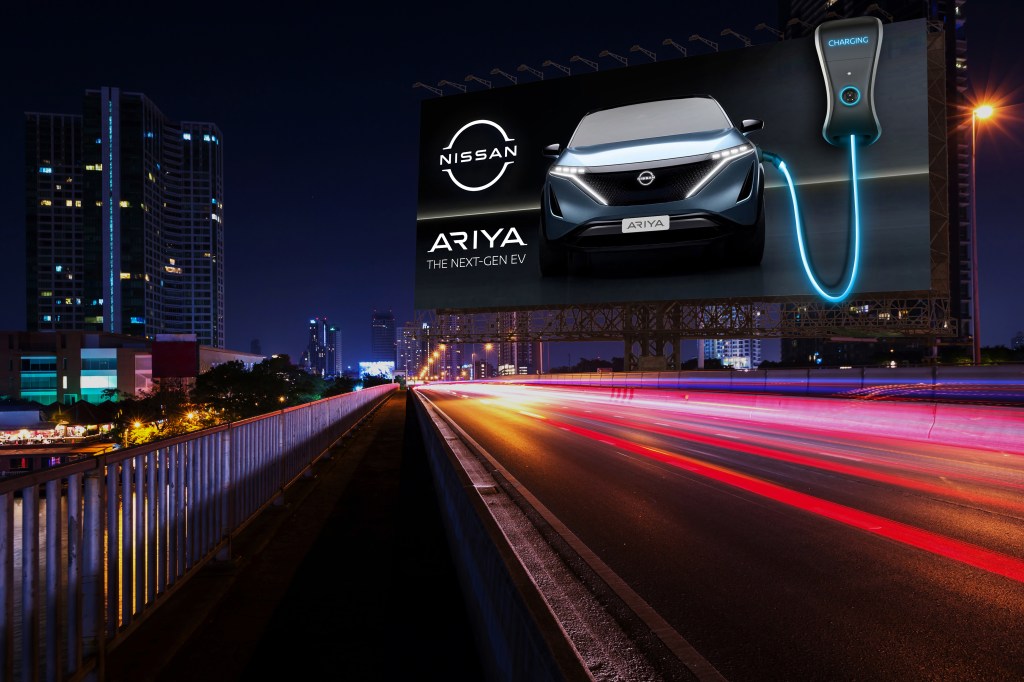
This concept shows that you no longer need to go and queue in a petrol station anymore. Your own private charging station will be installed at home. You can charge your car at your own time, day or night. This is the beauty of owning an electric vehicle.
The beauty of the charging station with out-of-the box executions illuminating the charging station at night. Several executions of day and night overtake the outdoor scenes showing the main advantage of owning an electric vehicle. For the first time, you can control your time.
With four core models offered, including two-wheel-drive and all-wheel-drive versions, the Ariya meets the driving needs of a wide range of customers. The Ariya two-wheel-drive model with 63 kWh of usable battery capacity is ideal for urban commuters and first time EV owners looking for quality and style in their next-generation EV. The Ariya two-wheel-drive model with 87 kWh of usable battery capacity offers a larger battery, delivering additional range for those looking to venture on longer journeys.
Staying true to Nissan’s heritage of producing fun-to-drive, exciting cars, the Ariya’s all-new EV platform has been optimized to deliver exceptional handling. The battery pack sits under the center of the vehicle to ensure a low center of gravity and near-equal weight distribution, front and rear. The battery pack’s flat design and integrated cross-member in the battery case, allow the Ariya to have a flat floor and impressive structural rigidity. Suspension components are optimized to take advantage of this, ensuring stable handling and a comfortable ride while also suppressing vibrations and noise from entering the cabin space.
While every Ariya model will feature impressive driving range in its segment, it also boasts remarkable range recovery and quick-charge performance. This is thanks in part to its battery thermal control feature, which constantly optimizes the operating temperature of the liquid-cooled battery. Using peak 130kW charging, the Ariya can recover up to 375 kilometers with a 30-minute quick charge using Japan’s CHAdeMO charging system.
As an example of how the Ariya promotes a seamless experience and comfort, drivers can check the status of the Ariya’s battery from the comfort of the breakfast table while enjoying a morning coffee.
Idea 2: Using leading edge technologies eg VR / AR to show
Focusing on the interior of the car showing the various features.

This concept revolves around experiencing Nissan’s Intelligent Integration features that come along with the SUV for the first time in the Kingdom of Bahrain through leading edge technology (VR/AR).
This concept revolves around Nissan’s Intelligent Integration features that comes along with the SUV for the first time in the Kingdom of Bahrain. The Ariya embodies Nissan’s philosophy of designing vehicles around the driver, making them both intuitive and exciting. This includes equipping it with the latest in connectivity, including a new human-machine interface and firmware updates over the air. Nissan’s intelligent personal assistance technology features a hybrid voice recognition system with advanced natural language understanding technology to handle in-vehicle assistance without the driver taking their eyes off the road. The Ariya also includes Amazon Alexa to help customers simplify and organize their lives. Alexa can play music, place calls, listen to audiobooks, control smart home devices and more, with just your voice. The two systems work hand in hand to provide a seamless, tailored user experience, whether during a daily commute or a weekend trip.
With a scheduled destination, the Intelligent Route Planner will send a reminder when it’s time to depart, keeping the day on-track. While driving, the system monitors road conditions and suggests alternative routes to keep travel times short. By using the NissanConnect smartphone app, calibration of the Ariya’s climate controls can be set just the way the driver likes, even before entering the vehicle.
When you approach the Nissan Ariya while carrying the Intelligent Key, the doors unlock. The exterior front and rear lights, as well as the Nissan emblem, switch on automatically, signaling that the vehicle detects the driver’s presence. The interior lights softly fade on when the door is opened, allowing the driver and passengers to see the entire cabin. The seat, steering wheel position and auto-sliding center console are all adjusted based on the saved driver profile linked with the Intelligent Key. The Ariya’s andon lighting treatment echoes a Japanese artisan character. After all occupants are seated and doors shut, the interior lighting fades away, prompting the driver to push the Start switch which produces a “pulsing” effect, inviting the driver to take hold of the steering wheel.
By saying “Hello Nissan” or “Hey Nissan,” occupants can ask for vehicle information and manage the travel route, including searching for points of interest, verbally In-vehicle functions such as selecting a playlist or adjusting the cabin temperature are effortlessly done without the driver needing to look away from the road. The Nissan Ariya’s in-vehicle commands are executed by a hybrid voice recognition system based on natural-language understanding, allowing for normal, conversational sentences. With a Wi-Fi connection, the system can access cloud data to better understand unique requests.
On the drive home, Alexa can be invoked to perform vehicle-to-home functions, including turning on interior home lighting or opening the garage door. “Nissan’s intelligent personal assistance technology is an expression of omotenashi – the Japanese custom of respecting the customer to the highest degree. It provides a seamless experience, both off- and on-board. The Ariya supports your lifestyle whether from home or on the go.
Omar Mal,
November 10, 2020
 Omar Mal