About Bahrain
Located in one of the world’s chief oil-producing regions, Bahrain itself has only small stores of petroleum. Instead, its economy has long relied on processing crude oil from neighbouring countries, and more recently the financial, commercial services, and communications sectors have grown markedly, as has tourism. The country’s chief city, port, and capital, Manama (Al-Manāmah), is located on the northeastern tip of Bahrain Island. A strikingly modern city, Manama is relaxed and cosmopolitan and is a favourite destination for visitors from neighbouring Saudi Arabia. Yet the people of Bahrain remain conservative in their lifeways. This sentiment is enshrined in the country’s constitution, which affirms that “the family is the cornerstone of society, the strength of which lies in religion, ethics, and patriotism.”
Bahrain’s island location has made it unique among Persian Gulf states. With greater access to ocean travel and broader exposure to outside influences, Bahrain traditionally has been home to a more ethnically and religiously diverse and cosmopolitan population than have other, more insular gulf states. This openness is reflected in Bahrain’s social customs, which—although still conservative—are much more moderate and relaxed than those of its neighbours, particularly conservative Saudi Arabic. Thus, although Bahrain is still at heart an Arab-Islamic country, it has been more accepting of modernization and Westernization than many of its neighbours.
Traditional handicraft industries receive state and popular support, and most villages practice specialized traditions; A’ali, for example, is well known for its ceramics, while artists in Karbābād weave baskets from date-palm leaves. Throughout the country artisans engage in gold working, tinsmithing, and textile making and sell their wares at small shops or the Souk Al-Arabaʿāʾ (“Wednesday Market”) in Manama. Shipyards at Manama and Al-Muḥarraq are sites of dhow building, a highly respected art form. The museum in Manama contains local artifacts dating from antiquity, such as ivory figurines, pottery, copper articles, and gold rings, many of which reflect various cultural influences from outside Bahrain. There is also a small but flourishing avant-garde art community.
Arabic is the official language of Bahrain. English is widely used, however, and is a compulsory second language at all schools. Persian is also common, although it is spoken mostly at home. A number of other languages are spoken among expatriates in Bahrain, including Urdu, Hindi, and Tagalog.
Source: Britannica.com
A Brief History of Arabic Calligraphy
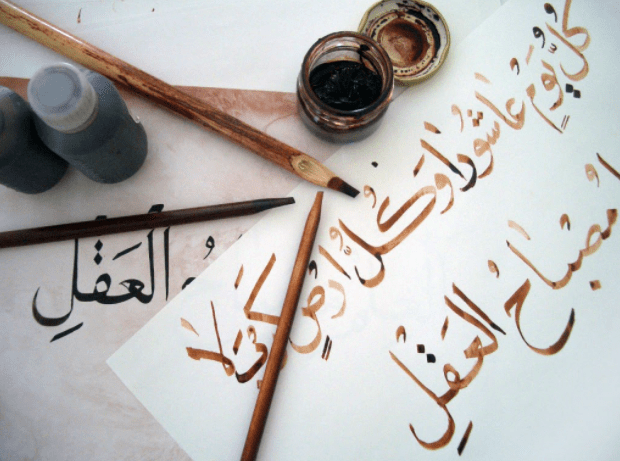
Calligraphy is one of the world’s most ancient and respected art forms. In many parts of the world, the practice and importance of calligraphy has waned, but in Arabic culture, the more than 2,000-year-old tradition remains as vibrant and revered as ever. At a moment in contemporary culture when the ubiquity of words seems to decrease their value, Arabic calligraphy offers a strong and appealing contrast by treating writing and the written word as sacred things.
Origins of Arabic Calligraphy
Traditionally, Arabic tribes preferred to memorize text and poetry and orally pass it on from generation to generation. However, that changed with the spread of Islam and the growing importance of preserving the Quran in written form. Below, we outline the history of Arabic script and calligraphy.
The Spread of Islam
Before the spread of Islam, the Arabian Peninsula was home to a variety of early semitic languages, and the discovery of calligraphic artifacts in these early languages prove that the practice of calligraphy predates Islam. Ancient Persia, for instance, was using cuneiform calligraphy to adorn the monuments of kings as early as 600–500 B.C.1 Nevertheless, it was undoubtedly the spread of Islam that ushered in a great age of calligraphy throughout the ancient Middle East because of how it unified the region under the Arabic language and because of its veneration of the written word.
Evolution Of Arabic Calligraphy
Beyond the expansion of Arabic calligraphy across geographic locations, the art form evolved in its main applications. Originally, Arabic calligraphy was a tool for communications and preserving the word of God through the Quran. However, over time, it also became an important element in architecture, decoration, and coin design.
In addition, Arabic calligraphy also evolved over time into two distinct families: Kufic and rounded scripts.
Kufic
Very early Arabic script was rarely used, because of the culture’s strong oral tradition. However, when the Quran needed to be preserved during the spread of Islam, the Arabic language became much more important. As a result, the script was made purposefully beautiful. This version of the script is called Kufic.
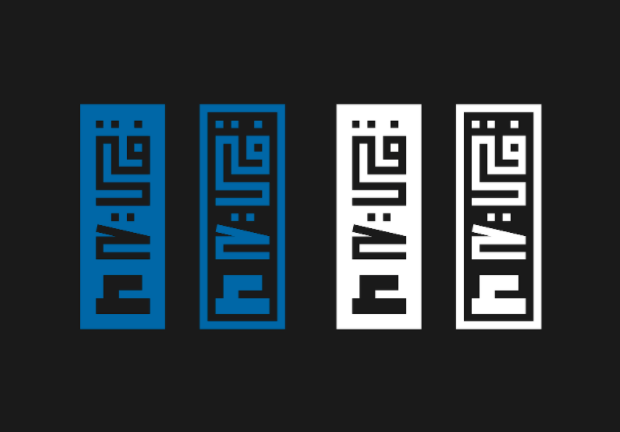
Today, there are several styles of Kufic, but overall, it is characterized by angular, rectilinear letterforms and a horizontal orientation.

Rounded Scripts
While Kufic became standard for sacred texts, there developed a need for a script that was quicker to write and better suited for documents of a smaller scale, like letters. These types of script, now called round scripts, are considered formal. Ideally, rounded script should not look like a human hand has written it, so there’s little to no room for creative expression when writing in this style.
Modern Arabic Calligraphy
While Arabic calligraphy is heavily grounded in tradition, it serves as inspiration for modern art. In fact, many contemporary artists have developed their own style and techniques for Arabic calligraphy. Modern artists may put their own spin on traditional letterforms and mediums, incorporating calligraphy into jewelry and digital designs, or using paint on canvas, rather than ink on paper.
Source: https://www.skillshare.com/blog/learn/a-brief-history-of-arabic-calligraphy
Workshop Challenge
Omar Mal,
February 3, 2021
 Omar Mal