
According to Visual Writer, it may be on stage, or on screen, or even in a novel. It is a scene or a story that is so well presented that you are completely immersed in it. The story seems completely real.
Visual writing is the language of stories. This language translates a vision of some potential reality, including settings, events, motivation, and dialogue, into aesthetics, movement, and dramatic action, that can be presented cinematically. If writers were able to do this, they would be writing “shooting scripts” and directing, and their names would be given prominence at the front of the film. But few writers can write visually, so directors have someone else translate the script into visual language, if it gets done at all.
Effective communication has been studied for over a century. What is plain is that the effectiveness of communication is greatly enhanced (up to 90%) by the addition of nonverbal cues: body language, movement, action, etc.
Visual writing’s three characteristics:
- It constructs dramatic action so that the reader visualizes the character’s experience. This includes the set, symbols, the motif, and the set as character.
- It constructs dramatic action so that the producer and director can easily translate the story to screen.
- It projects dramatic action primarily from the experience of the character, and secondarily from the writer. Doing it should begin from understanding what an actor does. It is not the writer telling the tale, it’s the characters.
The word “visual,” as I use it on this site, means “The totality of the visual medium in creating an effect,” including all things that accompany a visual image to convey a reflection of life. This applies to books as well, because the author’s descriptions of settings and drama create mental images. I think that many elements are blended in visual writing. They include the basics first:
- Honesty. Honest characters getting into honest situations, causing honest events, and finding honest solutions. The more honest, the more involved we become. (Note: “realism” isn’t the issue here.)
- Drama that engages the reader or viewer. If you can’t answer the question, “What does it mean to the character – what are the stakes?” then it isn’t engaging drama.
- Dramatic action that reveals the character’s emotions, conflicts, and decisions – leaving much less to dialogue and “telling” about inner states.
- The effective use of symbols for communicating experience.
- Engaging the reader or viewer’s imagination by not showing everything in complete detail. For example, “Black-box theater” works amazingly well.
- Character physical action involved with the setting.
- Settings that complement the dramatic action.
- Motifs (music, sound, images, scenes) that help establish mood.
What is visual communication?

“Visual communications,” in the sense that I use it on this Web site, I describe as the communication of meaning through images, through touching basic needs (such as love) and experiential memories (knowledge, experience, and emotion). These images may be spatially located, or virtually generated through language and other associations. The images are signs or symbols that are typically spontaneously assigned meaning.
“Signs” point to something else. For example, a personal object that is accidentally left lying on the floor, points to the person that left it, and signifies their prior presence. “Symbols,” as I use the term, participate in our experience. Most story images are symbols, pointing to either a basic need, or to an assigned experience to which we can relate.
“Visual writing,” I describe as the use of the written medium to virtually generate images. Visual writing focuses the mind, drawing into focus distinct details from the intricately interconnect experiences of the individual.
Visual writing is a good language for storytelling in any medium, and it is the writing form most closely representing the action filmed in a movie.
In film, the dramatic action unravels through images, which is composed of partly spatial images, and partly verbally generated images, which form a coherent story. Written in a visual language, stories are more effectively presented through actors, setting, dialogue, and action.
Visual communication engages meaningful experiences and feelings within individuals through richly embedded image symbols which are conveyed either directly through sight, or indirectly through other communications that trigger images as responses that generate or enhance visual communication.
Meaningful experiences typically convey more than facts or information – when sequentially presented they convey drama. Sight conveys characters, emotion, costumes, settings, situations, and culture. Non-sight (dialogue) also conveys characters, emotion, settings (sounds), situations, mood (motif), and culture.
Images can be created by using meaning laden words, and also by description.
Examples:
- “I stood there surrounded by police officers.”
- “I looked up as a giant wave hovered over me, a frothing blue mouth about to swallow me whole.”
- “The graph ramped downward on a steep ski slope trek.”
In a story the meaning of each image presented to the individual, whether through a film, a picture, or stimulated by language, gains its meaning from the context of preceding images which move the action of the story and continuously change it. No single image, even if the subject, setting, and miscellaneous artifacts are the same, carries the same meaning in all movies. The meaning of story images depends on context.
Source: https://www.visualwriter.com/ScriptDr/Advanced/WhatIsVis.htm
Workshop Challenge:
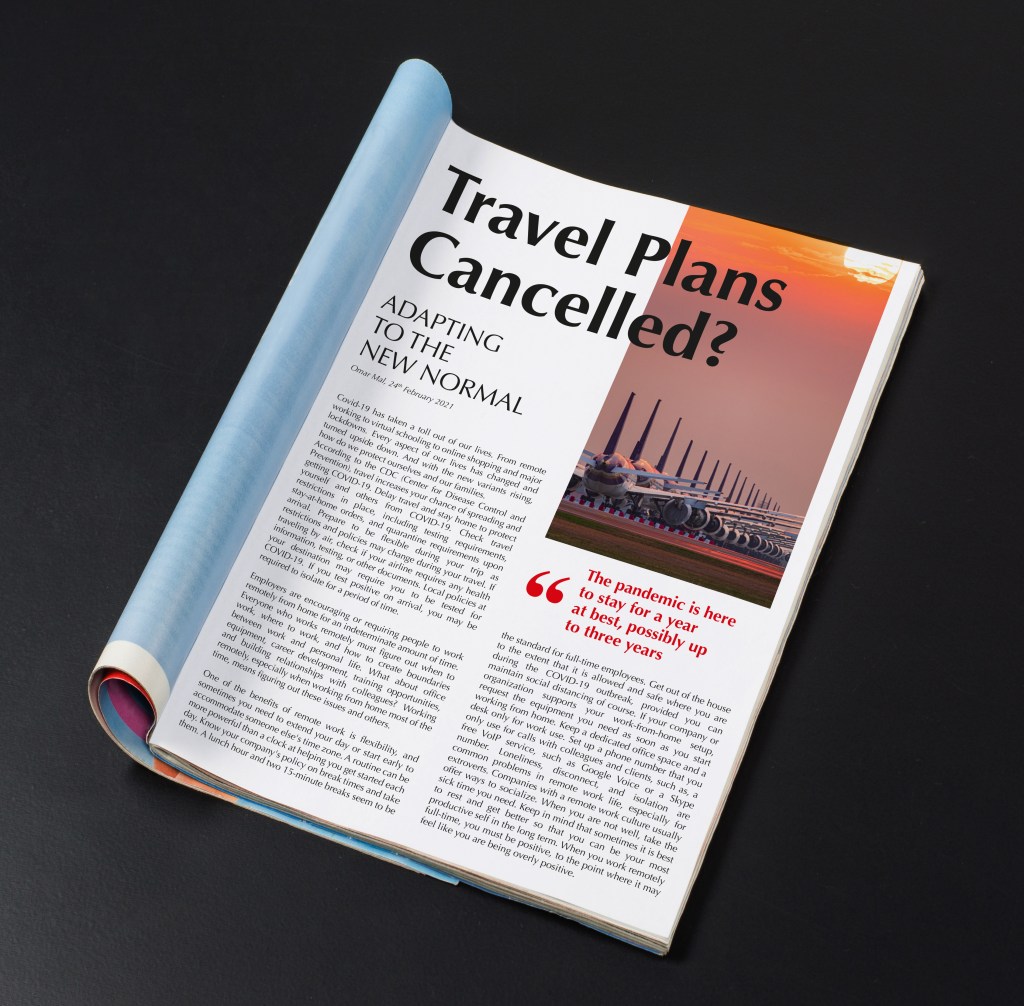
For this week’s challenge, I decided to go with the ‘news story’ tone of voice and create a rough design of an editorial to fit the news story topic of the COVID-19 pandemic and adapting to the new normal.
Travel Plans Cancelled?
ADAPTING TO THE NEW NORMAL
By: Omar Mal
Covid-19 has taken a toll out of our lives. From remote working to virtual schooling to online shopping and major lockdowns. Every aspect of our lives has changed and turned upside down. And with the new variants rising, how do we protect ourselves and our families.
According to the CDC (Center for Disease Control and Prevention), travel increases your chance of spreading and getting COVID-19. Delay travel and stay home to protect yourself and others from COVID-19. Check travel restrictions in place, including testing requirements, stay-at-home orders, and quarantine requirements upon arrival. Prepare to be flexible during your trip as restrictions and policies may change during your travel. If traveling by air, check if your airline requires any health information, testing, or other documents. Local policies at your destination may require you to be tested for COVID-19. If you test positive on arrival, you may be required to isolate for a period of time.
Employers are encouraging or requiring people to work remotely from home for an indeterminate amount of time. Everyone who works remotely must figure out when to work, where to work, and how to create boundaries between work and personal life. What about office equipment, career development, training opportunities, and building relationships with colleagues? Working remotely, especially when working from home most of the time, means figuring out these issues and others. One of the benefits of remote work is flexibility, and sometimes you need to extend your day or start early to accommodate someone else’s time zone. A routine can be more powerful than a clock at helping you get started each day. Know your company’s policy on break times and take them. A lunch hour and two 15-minute breaks seem to be the standard for full-time employees. Get out of the house to the extent that it is allowed and safe where you are during the COVID-19 outbreak, provided you can maintain social distancing of course. If your company or organization supports your work-from-home setup, request the equipment you need as soon as you start working from home. Keep a dedicated office space and a desk only for work use. Set up a phone number that you only use for calls with colleagues and clients, such as, a free VoIP service, such as Google Voice or a Skype number. Loneliness, disconnect, and isolation are common problems in remote work life, especially for extroverts. Companies with a remote work culture usually offer ways to socialize. When you are not well, take the sick time you need. Keep in mind that sometimes it is best to rest and get better so that you can be your most productive self in the long term. When you work remotely full-time, you must be positive, to the point where it may feel like you are being overly positive.
Omar Mal,
February 25, 2021
 Omar Mal